NEUROPEDAGOGÍA DIGITAL
EL NUEVO MAPA DEL APRENDIZAJE HUMANO
DOI:
https://doi.org/10.63816/b89sqx78Palabras clave:
Neuropedagogía digital, Inteligencia artificial educativa, Aprendizaje humano, Ecosistemas educativos, Neurociencia aplicadaResumen
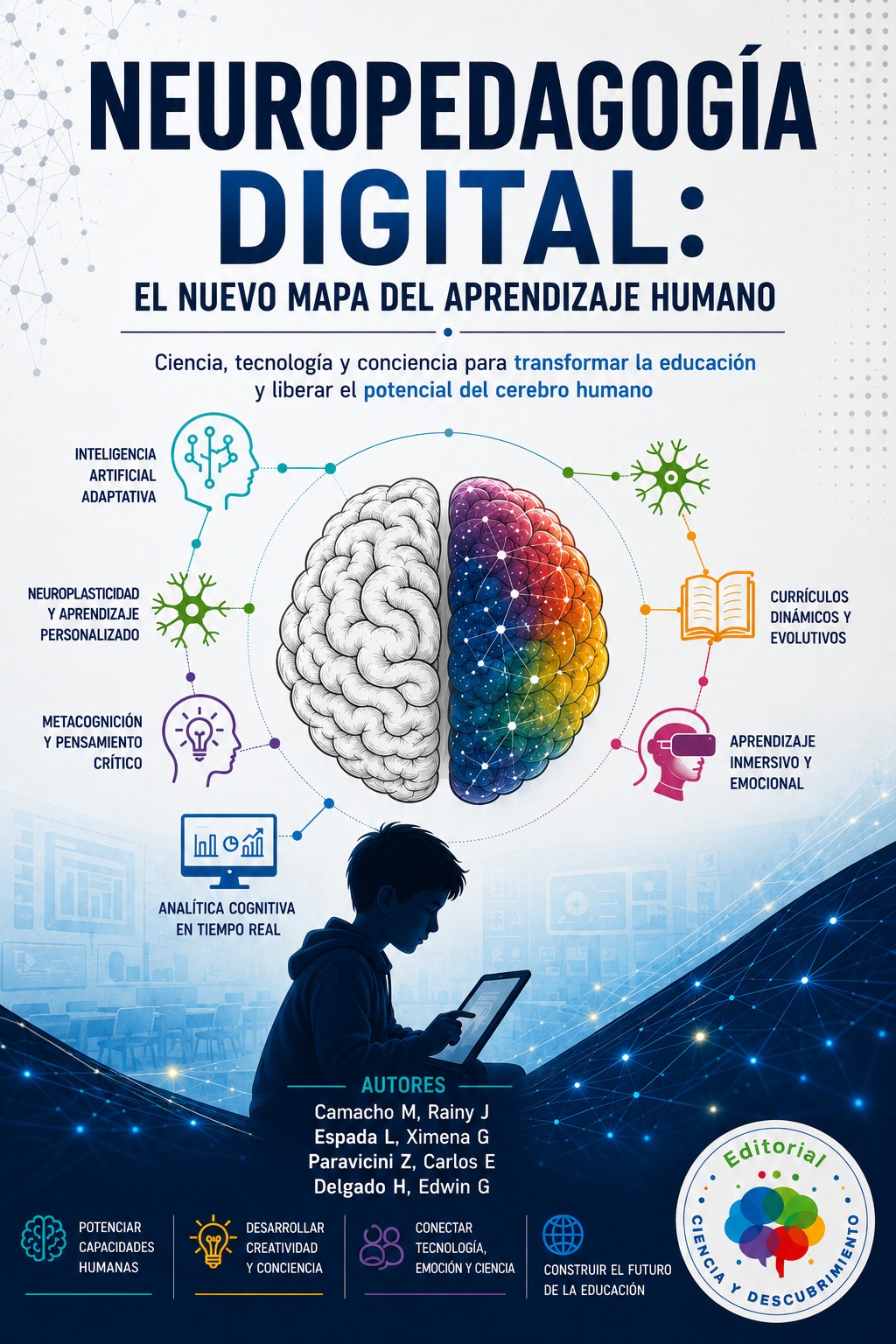
El libro "Neuropedagogía Digital: El nuevo mapa del aprendizaje humano" explora la convergencia entre la neurociencia, la pedagogía y la inteligencia artificial para transformar la educación contemporánea. La obra propone que la tecnología no debe sustituir el esfuerzo cognitivo ni la labor del docente, sino amplificar las capacidades humanas mediante ecosistemas inteligentes, currículos dinámicos y sistemas de aprendizaje adaptativo. Además, destaca la importancia de desarrollar competencias del siglo XXI, como el pensamiento crítico, la creatividad y la autorregulación, manteniendo un fuerte enfoque en la ética, la protección de los datos cognitivos y el humanismo digital para potenciar el desarrollo integral del estudiante.
Referencias
Alfredo, R., Echeverria, V., Jin, Y., Yan, L., Swiecki, Z., Gašević, D., & Martinez-Maldonado, R. (2024). Human-centred learning analytics and AI in education: A systematic literature review. Computers and Education: Artificial Intelligence, 6, 100215. https://doi.org/10.1016/j.caeai.2024.100215 DOI: https://doi.org/10.1016/j.caeai.2024.100215
Aljemely, A. S. (2024). Challenges and best practices in training teachers to utilize artificial intelligence: A systematic review. Frontiers in Education, 9, 1470853. https://doi.org/10.3389/feduc.2024.1470853 DOI: https://doi.org/10.3389/feduc.2024.1470853
Almasri, F. (2024). Exploring the impact of artificial intelligence in teaching and learning of science: A systematic review of empirical research. Research in Science Education, 54, 977–997. https://doi.org/10.1007/s11165-024-10176-3 DOI: https://doi.org/10.1007/s11165-024-10176-3
Atchley, P., Pannell, H., Wofford, K., Hopkins, M., & Atchley, R. A. (2024). Human and AI collaboration in the higher education environment: Opportunities and concerns. Cognitive Research: Principles and Implications, 9, 20. https://doi.org/10.1186/s41235-024-00547-9 DOI: https://doi.org/10.1186/s41235-024-00547-9
Bayly-Castaneda, K., Ramirez-Montoya, M. S., & Morita-Alexander, A. (2024). Crafting personalized learning paths with AI for lifelong learning: A systematic literature review. Frontiers in Education, 9, 1424386. https://doi.org/10.3389/feduc.2024.1424386 DOI: https://doi.org/10.3389/feduc.2024.1424386
Camacho Marín, R. J., Belduma Rentería, L. A., Erazo Buenaño, J. S., Almeida García, E. V., & Tipán Chiguano, I. M. (2026). El futuro de la educación: Tendencias y estrategias para un aprendizaje eficiente. Revista Multidisciplinar Ciencia y Descubrimiento, 4(3). https://doi.org/10.63816/a7kfj877 DOI: https://doi.org/10.63816/a7kfj877
Camacho Marín, R. J., & Camacho Marín, R. A. (2025). Teoría del aprendizaje colaborativo y contextualizado (TACC): Un enfoque innovador para el desarrollo de habilidades en contextos reales. Editorial Ciencia y Descubrimiento. https://doi.org/10.63816/5sa1zc51 DOI: https://doi.org/10.63816/293895igphqw
Camacho Marín, R. J., Colcha Pérez, J. R., & Cadena Heredia, V. F. (2026). Revolución neurocognitiva: Desbloqueando el poder oculto de la mente. Revista Multidisciplinar Ciencia y Descubrimiento, 4(3). https://doi.org/10.63816/n3ks7p94 DOI: https://doi.org/10.63816/n3ks7p94
Casal-Otero, L., Catala, A., Fernández-Morante, C., Taboada, M., Cebreiro, B., & Barro, S. (2023). AI literacy in K-12: A systematic literature review. International Journal of STEM Education, 10, 29. https://doi.org/10.1186/s40594-023-00418-7 DOI: https://doi.org/10.1186/s40594-023-00418-7
Castro González, A. E. (2026). Hackeando el cerebro: Inteligencia artificial y la nueva revolución del aprendizaje. Editorial Ciencia y Descubrimiento. https://doi.org/10.63816/wc7rry63 DOI: https://doi.org/10.63816/wc7rry63
Claro, M., Salinas, Á., Cabello-Hutt, T., San Martín, E., Preiss, D. D., Valenzuela, S., & Jara, I. (2024). A systematic review of quantitative research on teachers' digital competence. Computers & Education, 211, 104982. https://doi.org/10.1016/j.compedu.2024.104982
Costa, R. L. S. (2023). Neurociência e aprendizagem. Revista Brasileira de Educação, 28, e280010. https://doi.org/10.1590/S1413-24782023280010 DOI: https://doi.org/10.1590/s1413-24782023280010
Cueva Aguirre, N. P. (2026). Neurociencia, pedagogía e inteligencia artificial: Fundamentos científicos para el aprendizaje humano. Editorial Ciencia y Descubrimiento. https://doi.org/10.63816/abyexe75 DOI: https://doi.org/10.63816/abyexe75
Demmans Epp, C., Daniel, B. K., & Muldner, K. (2023). Learning analytics for supporting individualization: Data-informed adaptation of learning. Frontiers in Education, 8, 1240377. https://doi.org/10.3389/feduc.2023.1240377 DOI: https://doi.org/10.3389/feduc.2023.1240377
Dias, N. M., Helsdingen, I. E., de Lins, E. K. R. M., Etcheverria, C. E., Dechen, V. A., Steffen, L., Cardoso, C. O., & Lopes, F. M. (2024). Executive functions beyond the “Holy Trinity”: A scoping review. Neuropsychology, 38(2), 107–125. https://doi.org/10.1037/neu0000922 DOI: https://doi.org/10.1037/neu0000922
Díaz, B., & Nussbaum, M. (2024). Artificial intelligence for teaching and learning in schools: The need for pedagogical intelligence. Computers & Education. https://doi.org/10.1016/j.compedu.2024.105071 DOI: https://doi.org/10.1016/j.compedu.2024.105071
Dörrenbächer-Ulrich, L., & Bregulla, M. (2024). The relationship between self-regulated learning and executive functions—A systematic review. Educational Psychology Review, 36, 95. https://doi.org/10.1007/s10648-024-09932-8 DOI: https://doi.org/10.1007/s10648-024-09932-8
Dörrenbächer-Ulrich, L., Dilhuit, S., & Perels, F. (2024). Investigating the relationship between self-regulated learning, metacognition, and executive functions by focusing on academic transition phases: A systematic review. Current Psychology, 43, 16045–16072. https://doi.org/10.1007/s12144-023-05551-8 DOI: https://doi.org/10.1007/s12144-023-05551-8
Du Plooy, E., Casteleijn, D., & Franzsen, D. (2024). Personalized adaptive learning in higher education: A scoping review of key characteristics and impact on academic performance and engagement. Heliyon, 10(21), e39630. https://doi.org/10.1016/j.heliyon.2024.e39630 DOI: https://doi.org/10.1016/j.heliyon.2024.e39630
European Commission. (2022). Ethical guidelines on the use of artificial intelligence (AI) and data in teaching and learning for educators. Publications Office of the European Union. https://doi.org/10.2766/153756
European Commission. (2022). The Digital Competence Framework for Citizens: DigComp 2.2. Publications Office of the European Union. https://doi.org/10.2760/115376
González-Cabrera, J., Tourón, J., & Machimbarrena, J. M. (2024). Neuroplasticity and educational innovation: Implications for teaching and learning. Frontiers in Education, 9, 1452183. https://doi.org/10.3389/feduc.2024.1452183
Guerra, L. B. (2023). Neurociência e aprendizagem. Revista Brasileira de Educação, 28, e280010. https://doi.org/10.1590/S1413-24782023280010 DOI: https://doi.org/10.1590/s1413-24782023280010
Halkiopoulos, C., & Gkintoni, E. (2024). Leveraging AI in e-learning: Personalized learning and adaptive assessment through cognitive neuropsychology—A systematic analysis. Electronics, 13(18), 3762. https://doi.org/10.3390/electronics13183762 DOI: https://doi.org/10.3390/electronics13183762
Jin, Y., Yan, L., Echeverria, V., Gašević, D., & Martinez-Maldonado, R. (2024). AI in education, learner control, and human-AI collaboration. International Journal of Artificial Intelligence in Education, 34(1), 122–135. https://doi.org/10.1007/s40593-023-00356-z DOI: https://doi.org/10.1007/s40593-023-00356-z
Kasneci, E., Sessler, K., Küchemann, S., Bannert, M., Dementieva, D., Fischer, F., et al. (2023). ChatGPT for good? On opportunities and challenges of large language models for education. Learning and Individual Differences, 103, 102274. https://doi.org/10.1016/j.lindif.2023.102274 DOI: https://doi.org/10.1016/j.lindif.2023.102274
Kim, J., Yu, S., & Li, N. (2025). Designing AI-powered learning: Adult learners’ expectations for curriculum and human-AI interaction. Educational Technology Research and Development, 73, 3397–3421. https://doi.org/10.1007/s11423-025-10549-z DOI: https://doi.org/10.1007/s11423-025-10549-z
King, J., Marcus, T., & Markant, J. (2023). Individual differences in selective attention and engagement shape students' learning from visual cues and instructor presence during online lessons. Scientific Reports, 13, 5075. https://doi.org/10.1038/s41598-023-32069-7 DOI: https://doi.org/10.1038/s41598-023-32069-7
Lee, S. J., & Kwon, K. (2024). A systematic review of AI education in K–12 classrooms from 2018 to 2023: Topics, strategies, and learning outcomes. Computers and Education: Artificial Intelligence, 6, 100211. https://doi.org/10.1016/j.caeai.2024.100211 DOI: https://doi.org/10.1016/j.caeai.2024.100211
Lintner, T. (2024). A systematic review of AI literacy scales. npj Science of Learning, 9, 50. https://doi.org/10.1038/s41539-024-00264-4 DOI: https://doi.org/10.1038/s41539-024-00264-4
Liu, X., & Zhong, B. (2024). A systematic review on how educators teach AI in K–12 education. Educational Research Review, 45, 100642. https://doi.org/10.1016/j.edurev.2024.100642 DOI: https://doi.org/10.1016/j.edurev.2024.100642
Lo, C. K. (2023). What is the impact of ChatGPT on education? A rapid review of the literature. Education Sciences, 13(4), 410. https://doi.org/10.3390/educsci13040410 DOI: https://doi.org/10.3390/educsci13040410
Mustafa, M. Y., Tlili, A., Lampropoulos, G., Huang, R., Jandrić, P., Zhao, J., et al. (2024). A systematic review of literature reviews on artificial intelligence in education (AIED): A roadmap to a future research agenda. Smart Learning Environments, 11, 59. https://doi.org/10.1186/s40561-024-00350-5 DOI: https://doi.org/10.1186/s40561-024-00350-5
Mystakidis, S., Christopoulos, A., & Pellas, N. (2022). A systematic mapping review of augmented reality applications to support STEM learning in higher education. Education and Information Technologies, 27, 1883–1927. https://doi.org/10.1007/s10639-021-10682-1 DOI: https://doi.org/10.1007/s10639-021-10682-1
Naveh-Benjamin, M., & Cowan, N. (2023). The roles of attention, executive function and knowledge in cognitive ageing of working memory. Nature Reviews Psychology, 2, 151–165. https://doi.org/10.1038/s44159-023-00149-0 DOI: https://doi.org/10.1038/s44159-023-00149-0
Ouyang, F., Zheng, L., & Jiao, P. (2022). Artificial intelligence in online higher education: A systematic review of empirical research from 2011 to 2020. Education and Information Technologies, 27, 7893–7925. https://doi.org/10.1007/s10639-022-10925-9 DOI: https://doi.org/10.1007/s10639-022-10925-9
Pradeep, K., Sulur Anbalagan, R., Thangavelu, A. P., Aswathy, S., Jisha, V. G., & Vaisakhi, V. S. (2024). Neuroeducation: Understanding neural dynamics in learning and teaching. Frontiers in Education, 9, 1437418. https://doi.org/10.3389/feduc.2024.1437418 DOI: https://doi.org/10.3389/feduc.2024.1437418
Sperling, K., Stenberg, C.-J., McGrath, C., Åkerfeldt, A., Heintz, F., & Stenliden, L. (2024). In search of artificial intelligence (AI) literacy in teacher education: A scoping review. Computers and Education Open, 6, 100169. https://doi.org/10.1016/j.caeo.2024.100169 DOI: https://doi.org/10.1016/j.caeo.2024.100169
UNESCO. (2023). Guidance for generative AI in education and research. UNESCO. https://doi.org/10.54675/EWZM9535 DOI: https://doi.org/10.54675/EWZM9535
Voss, M. W., et al. (2024). Maintaining a dynamic brain: A review of empirical findings describing the roles of exercise, learning, and environmental enrichment in neuroplasticity from 2017–2023. Brain Plasticity. https://doi.org/10.3233/BPL-230151 DOI: https://doi.org/10.3233/BPL-230151
Wang, S., Wang, F., Zhu, Z., Wang, J., Tran, T., & Du, Z. (2024). Artificial intelligence in education: A systematic literature review. Expert Systems with Applications, 252, 124167. https://doi.org/10.1016/j.eswa.2024.124167 DOI: https://doi.org/10.1016/j.eswa.2024.124167
Wang, X., Huang, R., Sommer, M., Pei, B., Shidfar, P., Rehman, M. S., Ritzhaupt, A. D., & Martin, F. (2024). The efficacy of artificial intelligence-enabled adaptive learning systems from 2010 to 2022 on learner outcomes: A meta-analysis. Journal of Educational Computing Research, 62(6). https://doi.org/10.1177/07356331241240459 DOI: https://doi.org/10.1177/07356331241240459
Yuste, R. (2023). Advocating for neurodata privacy and neurotechnology regulation. Nature Protocols, 18, 2869–2875. https://doi.org/10.1038/s41596-023-00873-0 DOI: https://doi.org/10.1038/s41596-023-00873-0
Descargas
Publicado
Número
Sección
Licencia
Derechos de autor 2026 Dr. Camacho Marín Rainy José, Espada Leyton Ximena Guadalupe, Paravicini Zarate Carlos Ernesto, Delgado Herrera Edwin Giovanny (Autor/a)

Esta obra está bajo una licencia internacional Creative Commons Atribución-NoComercial-CompartirIgual 4.0.
Esta obra está bajo una licencia internacional Creative Commons Atribución-Compartir Igual 4.0.
Los autores/as que publiquen en esta revista aceptan las siguientes condiciones:
- Los autores conservan todos los derechos morales y patrimoniales de sus obras, cediendo solamente a la AJRPT el derecho a la primera publicación de éste. En consecuencia, los autores pueden realizar otros acuerdos contractuales independientes y adicionales para la distribución del artículo o texto.
- Los autores/as conservarán sus derechos de autor y aceptan la licencia de distribución de AJRPT, la cuál es Licencia de Reconocimiento - Compartir Igual Creative Commons.
- Los autores/as pueden realizar otros acuerdos contractuales independientes y adicionales para la distribución de la versión del artículo publicado en esta revista (p. ej., incluirlo en un repositorio institucional o publicarlo en un libro) siempre que indiquen claramente que el trabajo se publicó por primera vez en esta revista.
- Se permite y recomienda a los autores/as a publicar su trabajo en Internet (por ejemplo, en páginas institucionales o personales) sólo una vez que sean publicados en la revista AJRPT, ya que puede conducir a intercambios productivos y a una mayor y más rápida difusión.
Cómo citar