
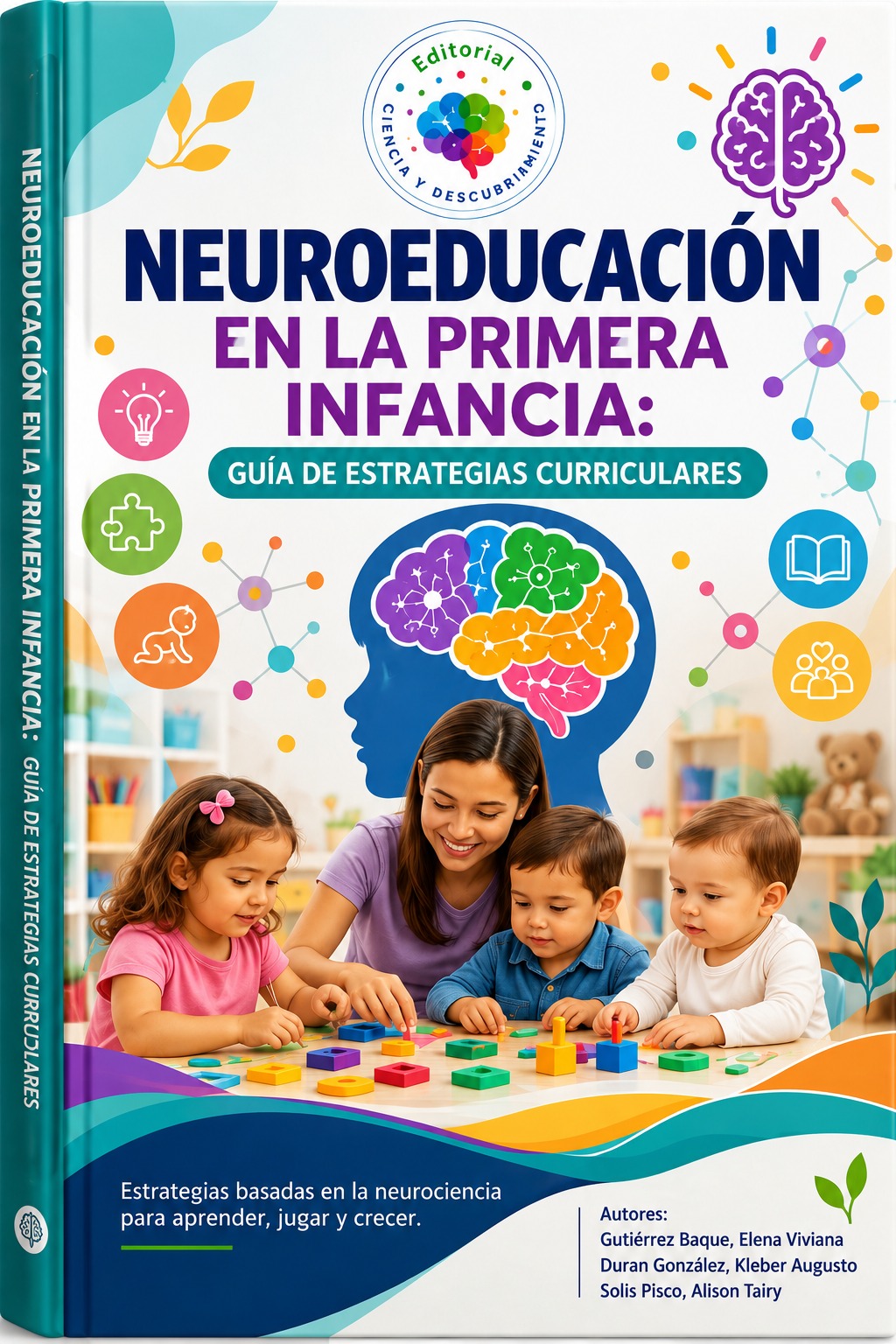
NEUROEDUCACIÓN EN LA PRIMERA INFANCIA
GUÍA DE ESTRATEGIAS CURRICULARES
DOI:
https://doi.org/10.63816/rnc46r89Palabras clave:
Neuroeducación , Primera infancia , Estrategias curriculares , Desarrollo cerebral , Funciones ejecutivasResumen
-
Esta obra aborda la integración de la neurociencia, la psicología y la pedagogía en el ámbito de la Educación Inicial, ofreciendo una guía práctica para enriquecer la planificación curricular desde una comprensión científica del desarrollo cerebral infantil.
-
El libro profundiza en los fundamentos neurocognitivos del aprendizaje en los primeros años de vida, analizando factores clave como la plasticidad cerebral, la atención, la memoria, las funciones ejecutivas y el rol determinante de la seguridad emocional y los vínculos afectivos.
-
Asimismo, traslada estos principios al diseño curricular activo a través del juego, la exploración multisensorial, el movimiento, la música y la narración, en ambientes estimulantes y seguros.
-
Finalmente, propone un enfoque inclusivo enfocado en la neurodiversidad, la eliminación de barreras para el aprendizaje, la corresponsabilidad familiar y una evaluación formativa basada en la observación y el acompañamiento pedagógico respetuoso.
Referencias
Alotaibi, M. S. (2024). Game-based learning in early childhood education: A systematic review and meta-analysis. Frontiers in Psychology, 15, 1307881. https://doi.org/10.3389/fpsyg.2024.1307881
Bautista, G. F., Ghesquière, P., & Torbeyns, J. (2024). Stimulating preschoolers’ early literacy development using educational technology: A systematic literature review. International Journal of Child-Computer Interaction, 39, 100620. https://doi.org/10.1016/j.ijcci.2023.100620
Bedoya Salazar, D. M., Mazuera Quiceno, C. A., & Arteaga, Á. P. (2024). Programa pedagógico basado en juegos sociomotrices para el desarrollo de las funciones ejecutivas en preescolares. Retos, 54, 715–720. https://doi.org/10.47197/retos.v54.100575
Caballero-Julia, D., Martín-Lucas, J., & Andrade-Silva, L. E. (2024). Unpacking the relationship between screen use and educational outcomes in childhood: A systematic literature review. Computers & Education, 215, 105049. https://doi.org/10.1016/j.compedu.2024.105049
Camacho Marín, R. J., Colcha Pérez, J. R., & Cadena Heredia, V. F. (2026a). Revolución neurocognitiva: Desbloqueando el poder oculto de la mente. Editorial Ciencia y Descubrimiento. https://doi.org/10.63816/n3ks7p94
Camacho Marín, R. J., Espada Leyton, X. G., Paravicini Zarate, C. E., & Delgado Herrera, E. G. (2026b). Neuropedagogía digital: El nuevo mapa del aprendizaje humano. Editorial Ciencia y Descubrimiento. https://doi.org/10.63816/b89sqx78
Center on the Developing Child at Harvard University. (2022). Brain-building through play: Activities for infants, toddlers, and children. https://developingchild.harvard.edu/topic/play/
Center on the Developing Child at Harvard University. (2024). A guide to executive function. https://developingchild.harvard.edu/topic/executive-function/
Chu, C., Paatsch, L., Kervin, L., & Edwards, S. (2024). Digital play in the early years: A systematic review. International Journal of Child-Computer Interaction, 40, 100652. https://doi.org/10.1016/j.ijcci.2024.100652
Dereli, F., & Türk Kurtça, T. (2023). Family engagement in early childhood education: A phenomenological study. International Journal of Psychology and Educational Studies, 10(3), 714–732. https://doi.org/10.52380/ijpes.2023.10.3.1232
Duncan, A. F., et al. (2024). Interventions to improve executive functions in children aged 3 years and under: A systematic review. Child: Care, Health and Development, 50(4), e13298. https://doi.org/10.1111/cch.13298
Fondo de las Naciones Unidas para la Infancia. (2024a). Logros de UNICEF Ecuador en 2024. https://www.unicef.org/ecuador/logros-de-unicef-ecuador-en-2024
Fondo de las Naciones Unidas para la Infancia. (2024b). Política Metropolitana de Primera Infancia. https://www.unicef.org/ecuador/informes/pol%C3%ADtica-metropolitana-de-primera-infancia
Gibbard, D., et al. (2024). A randomised controlled trial of the effectiveness of parent-based models of language intervention for 2- to 3-year-old children with speech, language and communication needs in areas of social disadvantage. International Journal of Language & Communication Disorders, 59(4), 1517–1537. https://doi.org/10.1111/1460-6984.13016
Levickis, P., Murray, L., Lee-Pang, L., Eadie, P., Page, J., & Lee, W. Y. (2023). Parents’ perspectives of family engagement with early childhood education and care during the COVID-19 pandemic. Early Childhood Education Journal, 51, 1279–1289. https://doi.org/10.1007/s10643-022-01376-5
Lewis, H. R., Lipscomb, S. T., Hatfield, B. E., Weber, R., Green, B., & Patterson, L. (2023). Family–teacher relationships and child engagement in early care and education. Societies, 13(3), 67. https://doi.org/10.3390/soc13030067
Llatance Ruiz, I. D. P., Ruiz Celi, R. D., Vicuña Peri, L. A., Rodríguez Vega, J. L., & Esteban Espinoza, D. (2024). Neuroeducación infantil temprana: Integrando la neurociencia al proceso de aprendizaje en la primera infancia: Una revisión sistemática. Educa-UMCH, (24), 78–93. https://doi.org/10.35756/educaumch.202424.294
Lu, Y., Shi, L., & Musib, A. F. (2025). Effects of music training on executive functions in preschool children aged 3–6 years: Systematic review and meta-analysis. Frontiers in Psychology, 15, 1522962. https://doi.org/10.3389/fpsyg.2024.1522962
Macrides, E., Miliou, O., & Angeli, C. (2022). Programming in early childhood education: A systematic review. International Journal of Child-Computer Interaction, 32, 100396. https://doi.org/10.1016/j.ijcci.2021.100396
McCarthy, C. (2023, 2 de febrero). Why play? Early games build bonds and brain. Harvard Health Publishing. https://www.health.harvard.edu/blog/why-play-early-games-build-bonds-and-brain-202302022884
Moffett, L., Weiland, C., McCormick, M. P., Hsueh, J., Snow, C., & Sachs, J. (2024). Off-task behavior as a measure of in-classroom executive function skills? Evidence for construct validity and contributions to gains in prekindergartners’ academic achievement. Early Education and Development, 35(4), 667–690.
Nagelhout, R. (2025, 14 de enero). Play helps children build better brains: Here are some ways to get kids learning. Harvard Graduate School of Education. https://www.gse.harvard.edu/ideas/usable-knowledge/25/01/play-helps-children-build-better-brains-here-are-some-ways-get-kids
Pérez-Marfil, M. N., Fernández-Alcántara, M., López-Benítez, R., Pérez-García, M., Pérez-García, M. P., & Cruz-Quintana, F. (2024). Effects of an executive function programme (PEFEN) on preschool children: A pilot study. Infancia y Aprendizaje, 47(1), 113–137. https://doi.org/10.1177/02103702231224641
Rodriguez-Gomez, D. A., & Talero-Gutiérrez, C. (2022). Effects of music training in executive function performance in children: A systematic review. Frontiers in Psychology, 13, 968144. https://doi.org/10.3389/fpsyg.2022.968144
Sagñay Illapa, B. E. (2024). La neurodidáctica y su impacto en el desarrollo infantil. Universidad, Ciencia y Tecnología, 28(125), 88–96. https://doi.org/10.47460/uct.v28i125.858
Skene, K., O’Farrelly, C., Byrne, E. M., Kirby, N., Stevens, E. C., & Ramchandani, P. G. (2022). Can guidance during play enhance children’s learning and development in educational contexts? A systematic review and meta-analysis. Child Development, 93(4), 1162–1180. https://doi.org/10.1111/cdev.13730
Swider-Cios, E., Vermeij, A., & Sitskoorn, M. M. (2023). Young children and screen-based media: The impact on cognitive and socioemotional development and the importance of parental mediation. Cognitive Development, 66, 101319. https://doi.org/10.1016/j.cogdev.2023.101319
Taylor, G., Sala, G., Kolak, J., Gerhardstein, P., & Lingwood, J. (2024). Does adult-child co-use during digital media use improve children’s learning aged 0–6 years? A systematic review with meta-analysis. Educational Research Review, 44, 100614. https://doi.org/10.1016/j.edurev.2024.100614
Taylor, K., Neild, R., & Fitzpatrick, M. (2023). Universal design for learning: Promoting access in early childhood education for deaf and hard of hearing children. Perspectives on Early Childhood Psychology and Education, 5(2), Article 4. https://doi.org/10.58948/2834-8257.1059
Vega-Fernandez, G., et al. (2026). Early childhood movement- and arts-based experiences and executive functions: A systematic review and meta-analysis. Children, 13(9), 1134. https://doi.org/10.3390/children13091134
Walsh, K., L’Estrange, L., Smith, R., Burr, T., & Williams, K. E. (2024). Translating neuroscience to early childhood education: A scoping review of neuroscience-based professional learning for early childhood educators. Educational Research Review, 45, 100644. https://doi.org/10.1016/j.edurev.2024.100644
Zhang, J., et al. (2024). Recreational gymnastics exercise of moderate intensity enhances executive function in Chinese preschoolers: A randomized controlled trial. PsyCh Journal, 13(6), 954–965. https://doi.org/10.1002/pchj.786
Descargas
Publicado
Número
Sección
Licencia
Derechos de autor 2026 Gutiérrez Baque Elena Viviana, Duran González Kleber Augusto, Solis Pisco Alison Tairy (Autor/a)

Esta obra está bajo una licencia internacional Creative Commons Atribución-NoComercial-CompartirIgual 4.0.
Esta obra está bajo una licencia internacional Creative Commons Atribución-Compartir Igual 4.0.
Los autores/as que publiquen en esta revista aceptan las siguientes condiciones:
- Los autores conservan todos los derechos morales y patrimoniales de sus obras, cediendo solamente a la AJRPT el derecho a la primera publicación de éste. En consecuencia, los autores pueden realizar otros acuerdos contractuales independientes y adicionales para la distribución del artículo o texto.
- Los autores/as conservarán sus derechos de autor y aceptan la licencia de distribución de AJRPT, la cuál es Licencia de Reconocimiento - Compartir Igual Creative Commons.
- Los autores/as pueden realizar otros acuerdos contractuales independientes y adicionales para la distribución de la versión del artículo publicado en esta revista (p. ej., incluirlo en un repositorio institucional o publicarlo en un libro) siempre que indiquen claramente que el trabajo se publicó por primera vez en esta revista.
- Se permite y recomienda a los autores/as a publicar su trabajo en Internet (por ejemplo, en páginas institucionales o personales) sólo una vez que sean publicados en la revista AJRPT, ya que puede conducir a intercambios productivos y a una mayor y más rápida difusión.
Cómo citar