
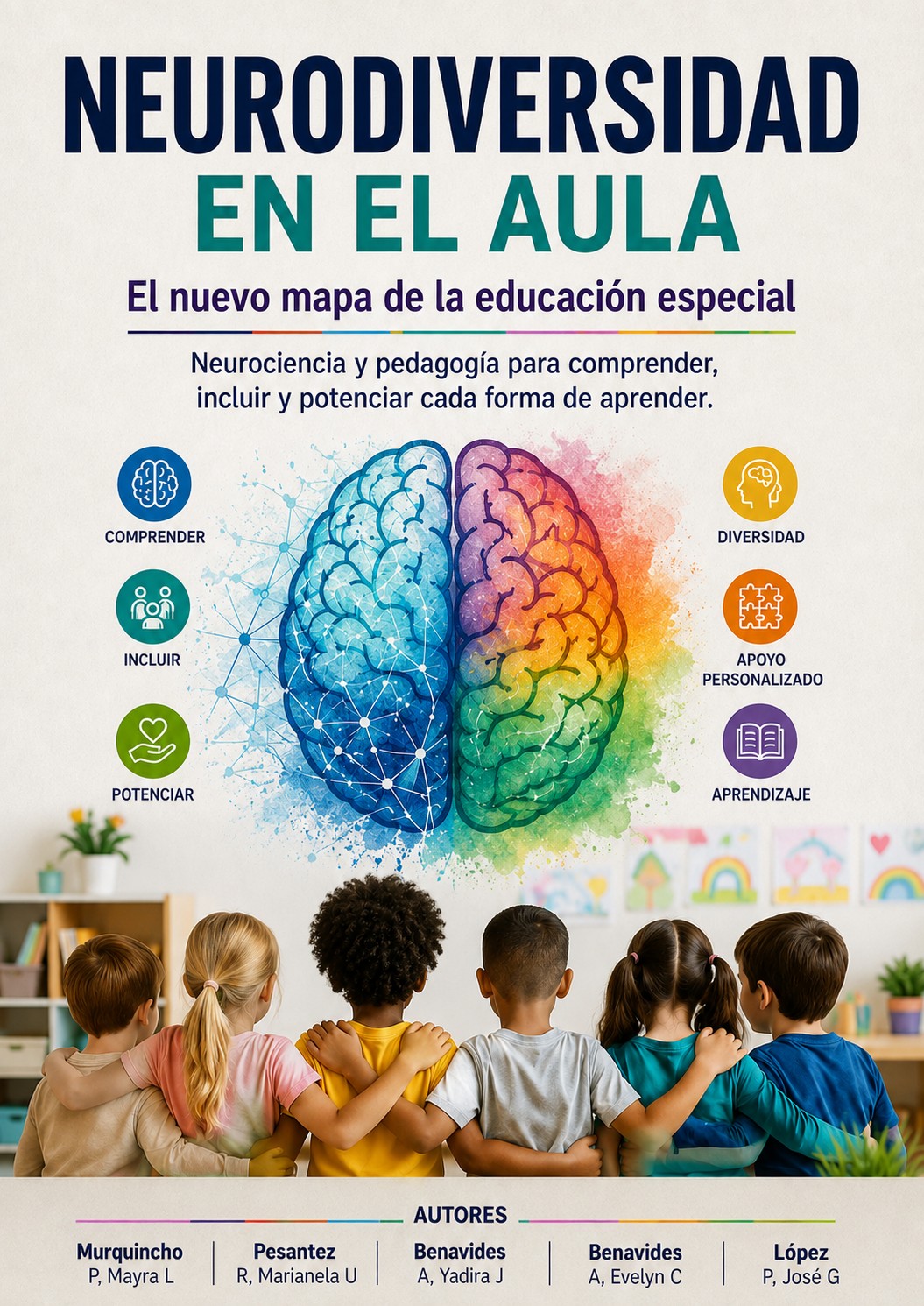
NEURODIVERSIDAD EN EL AULA
El nuevo mapa de la educación especial Neurociencia y pedagogía para comprender, incluir y potenciar cada forma de aprender.
DOI:
https://doi.org/10.63816/t1vwgp18Palabras clave:
Neurodiversidad educativa, Educación inclusiva, Diseño Universal para el Aprendizaje (DUA), Neuropedagogía, Perfiles neurocognitivosResumen
El libro "Neurodiversidad en el Aula: El nuevo mapa de la educación especial" plantea un cambio de paradigma en la educación, proponiendo transitar de una visión centrada en el déficit hacia un enfoque orientado a las fortalezas, potencialidades y apoyos del estudiante. La obra integra fundamentos de neurociencia y pedagogía para comprender la variabilidad de los procesos cognitivos y abordar diversos perfiles de aprendizaje, tales como el Trastorno del Espectro Autista (TEA), el TDAH, y las dificultades específicas del aprendizaje. Además, propone la aplicación del Diseño Universal para el Aprendizaje (DUA), el uso de metodologías activas y la integración ética de tecnologías de apoyo e inteligencia artificial para construir entornos educativos accesibles y flexibles que promuevan la autonomía y participación de todos los estudiantes.
Referencias
Allen, L. L., Mellon, L. S., Syed, N., Johnson, J. F., & Bernal, A. J. (2024). Neurodiversity-affirming applied behavior analysis. Behavior Analysis in Practice. https://doi.org/10.1007/s40617-024-00918-0 DOI: https://doi.org/10.1007/s40617-024-00918-0
American Psychiatric Association. (2022). Diagnostic and statistical manual of mental disorders (5th ed., text rev., DSM-5-TR). American Psychiatric Association Publishing. https://doi.org/10.1176/appi.books.9780890425787 DOI: https://doi.org/10.1176/appi.books.9780890425787
Appelbaum, L. G., Shenasa, M. A., Stolz, L., & Daskalakis, Z. (2023). Synaptic plasticity and mental health: Methods, challenges and opportunities. Neuropsychopharmacology, 48, 113–120. https://doi.org/10.1038/s41386-022-01370-w DOI: https://doi.org/10.1038/s41386-022-01370-w
Camacho Marín, R. J., Colcha Pérez, J. R., & Cadena Heredia, V. F. (2026). Revolución neurocognitiva: Desbloqueando el poder oculto de la mente. Revista Multidisciplinar Ciencia y Descubrimiento, 4(3). https://doi.org/10.63816/n3ks7p94 DOI: https://doi.org/10.63816/n3ks7p94
Camacho Marín, R. J., Espada Leyton, X. G., Paravicini Zarate, C. E., & Delgado Herrera, E. G. (2026). Neuropedagogía digital: El nuevo mapa del aprendizaje humano. Revista Multidisciplinar Ciencia y Descubrimiento, 4(3). https://doi.org/10.63816/b89sqx78 DOI: https://doi.org/10.63816/b89sqx78
Carpenter, S. K., Pan, S. C., & Butler, A. C. (2022). The science of effective learning with spacing and retrieval practice. Nature Reviews Psychology, 1, 496–511. https://doi.org/10.1038/s44159-022-00089-1 DOI: https://doi.org/10.1038/s44159-022-00089-1
CAST. (2024). Universal Design for Learning Guidelines version 3.0. CAST. UDL Guidelines 3.0
Cook, A. (2024). Conceptualisations of neurodiversity and barriers to inclusive pedagogy in schools: A perspective article. Journal of Research in Special Educational Needs, 24(3), 627–636. https://doi.org/10.1111/1471-3802.12656 DOI: https://doi.org/10.1111/1471-3802.12656
Donath, J. L., Lüke, T., Graf, E., Tran, U. S., & Götz, T. (2023). Does professional development effectively support the implementation of inclusive education? A meta-analysis. Educational Psychology Review, 35, Article 30. https://doi.org/10.1007/s10648-023-09752-2 DOI: https://doi.org/10.1007/s10648-023-09752-2
Dunlosky, J., Rawson, K. A., Marsh, E. J., Nathan, M. J., & Willingham, D. T. (2013). Improving students’ learning with effective learning techniques: Promising directions from cognitive and educational psychology. Psychological Science in the Public Interest, 14(1), 4–58. https://doi.org/10.1177/1529100612453266 DOI: https://doi.org/10.1177/1529100612453266
Lord, C., Charman, T., Havdahl, A., Carbone, P., Anagnostou, E., Boyd, B., Carr, T., de Vries, P. J., Dissanayake, C., Divan, G., Freitag, C. M., Gotelli, M. M., Kasari, C., Knapp, M., Mundy, P., Plank, A., Scahill, L., Servili, C., Shattuck, P., Simonoff, E., Singer, A. T., Slonims, V., Wang, P. P., Ysrraelit, M. C., Jellett, R., Pickles, A., Cusack, J., Howlin, P., Szatmari, P., Holbrook, A., Toolan, C., & McCauley, J. B. (2022). The Lancet Commission on the future of care and clinical research in autism. The Lancet, 399(10321), 271–334. https://doi.org/10.1016/S0140-6736(21)01541-5 DOI: https://doi.org/10.1016/S0140-6736(21)01541-5
Mutlu-Bayraktar, D. (2024). A systematic review of emotional design research in multimedia learning. Education and Information Technologies, 29, 24603–24626. https://doi.org/10.1007/s10639-024-12823-8 DOI: https://doi.org/10.1007/s10639-024-12823-8
Perdue, M. V., Mahaffy, K., Vlahcevic, K., Wolfman, E., Erbeli, F., Richlan, F., & Landi, N. (2022). Reading intervention and neuroplasticity: A systematic review and meta-analysis of brain changes associated with reading intervention. Neuroscience & Biobehavioral Reviews, 132, 465–494. https://doi.org/10.1016/j.neubiorev.2021.11.011 DOI: https://doi.org/10.1016/j.neubiorev.2021.11.011
Privitera, A. J., Ng, S. H. S., & Chen, S. H. A. (2023). Defining the science of learning: A scoping review. Trends in Neuroscience and Education, 32, Article 100206. https://doi.org/10.1016/j.tine.2023.100206 DOI: https://doi.org/10.1016/j.tine.2023.100206
Ramos-Galarza, C., Ramos, V., Del Valle, M., Lepe-Martínez, N., Cruz-Cárdenas, J., Acosta-Rodas, P., & Bolaños-Pasquel, M. (2023). Executive functions scale for university students: UEF-1. Frontiers in Psychology, 14, 1192555. https://doi.org/10.3389/fpsyg.2023.1192555 DOI: https://doi.org/10.3389/fpsyg.2023.1192555
Schalock, R. L., Luckasson, R., & Tassé, M. J. (2021). Intellectual disability: Definition, diagnosis, classification, and systems of supports (12th ed.). American Association on Intellectual and Developmental Disabilities. DOI: https://doi.org/10.1352/1944-7558-126.6.439
Snowling, M. J., & Hulme, C. (2024). Annual Research Review: The nature and classification of reading disorders – a commentary on proposals for DSM-5.5. Journal of Child Psychology and Psychiatry.
Van Duijvenvoorde, A. C. K., Whitmore, L. B., Westhoff, B., & Mills, K. L. (2022). A methodological perspective on learning in the developing brain. npj Science of Learning, 7, Article 12. https://doi.org/10.1038/s41539-022-00127-w DOI: https://doi.org/10.1038/s41539-022-00127-w
Xia, Y., Wang, P., & Vincent, J. (2024). Why we need neurodiversity in brain and behavioral sciences. Brain-X. https://doi.org/10.1002/brx2.70 DOI: https://doi.org/10.1002/brx2.70
Descargas
Publicado
Número
Sección
Licencia
Derechos de autor 2026 Murquincho Pinta Mayra Lizbeth, Pesantez Reyes Marianela Ubaldina, Benavides Armas Yadira Johana, Benavides Armas Evelyn Carolina, López Piña José Gregorio (Autor/a)

Esta obra está bajo una licencia internacional Creative Commons Atribución-NoComercial-CompartirIgual 4.0.
Esta obra está bajo una licencia internacional Creative Commons Atribución-Compartir Igual 4.0.
Los autores/as que publiquen en esta revista aceptan las siguientes condiciones:
- Los autores conservan todos los derechos morales y patrimoniales de sus obras, cediendo solamente a la AJRPT el derecho a la primera publicación de éste. En consecuencia, los autores pueden realizar otros acuerdos contractuales independientes y adicionales para la distribución del artículo o texto.
- Los autores/as conservarán sus derechos de autor y aceptan la licencia de distribución de AJRPT, la cuál es Licencia de Reconocimiento - Compartir Igual Creative Commons.
- Los autores/as pueden realizar otros acuerdos contractuales independientes y adicionales para la distribución de la versión del artículo publicado en esta revista (p. ej., incluirlo en un repositorio institucional o publicarlo en un libro) siempre que indiquen claramente que el trabajo se publicó por primera vez en esta revista.
- Se permite y recomienda a los autores/as a publicar su trabajo en Internet (por ejemplo, en páginas institucionales o personales) sólo una vez que sean publicados en la revista AJRPT, ya que puede conducir a intercambios productivos y a una mayor y más rápida difusión.
Cómo citar