
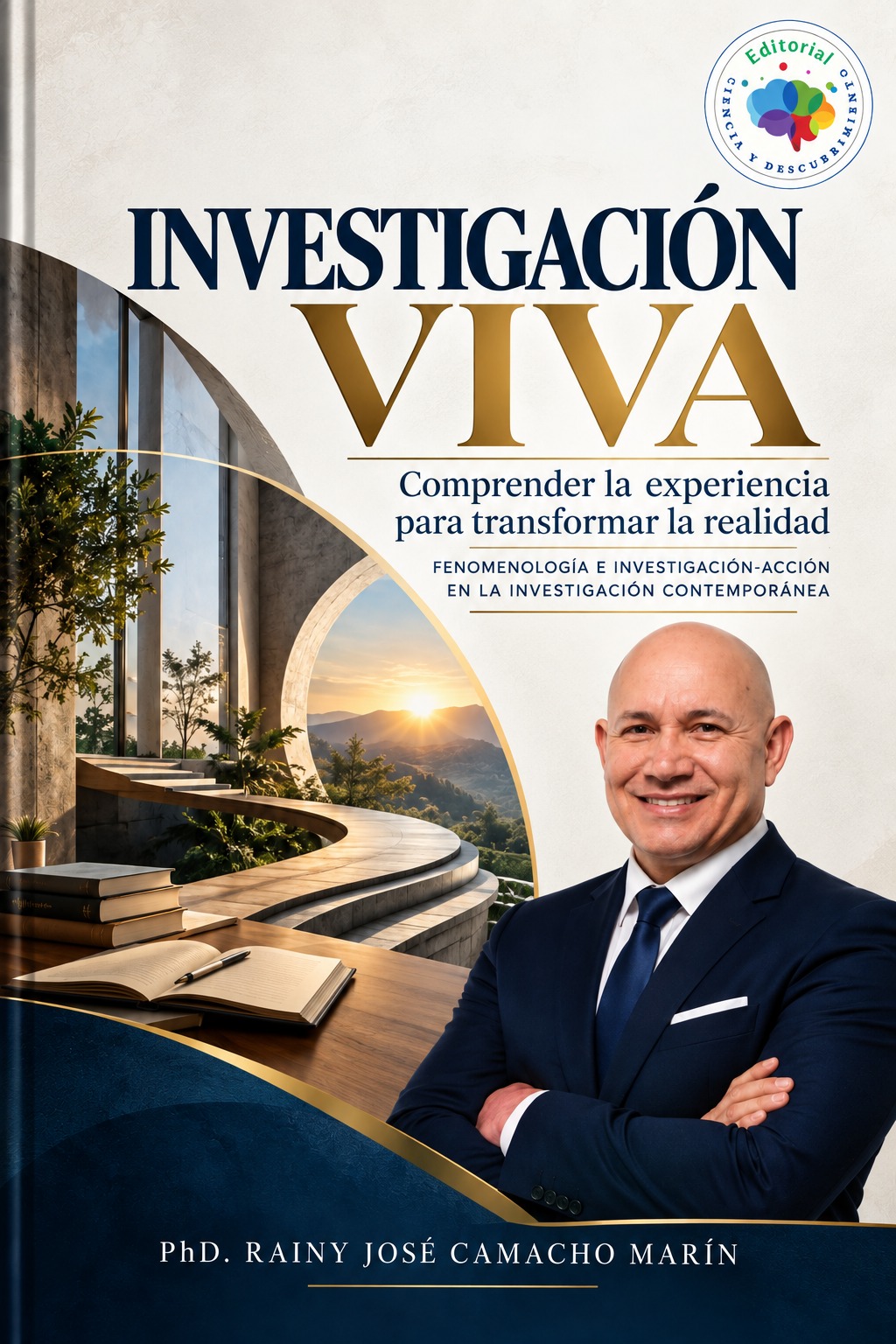
INVESTIGACIÓN VIVA
Comprender la experiencia para transformar la realidad Fenomenología e Investigación-Acción en la investigación contemporánea
DOI:
https://doi.org/10.63816/6n26z960Palabras clave:
Investigación Viva , Fenomenología , Investigación-acción , Experiencia vivida , Soberanía interpretativa humanaResumen
Investigación Viva: Comprender la experiencia para transformar la realidad propone un marco metodológico e interpretativo dentro de la investigación cualitativa contemporánea que articula la fenomenología y la investigación-acción. La obra sostiene que el proceso investigativo no culmina con la sola comprensión de un fenómeno, sino cuando el conocimiento construido retorna al contexto y genera posibilidades de cambio y emancipación. El autor introduce conceptos y herramientas metodológicas originales como la Profundidad Experiencial, el Dato Vivo, las Unidades Vivas de Significado, el Mapa Vivo de la Experiencia (MVE), la Ruta de Comprensión Fenomenológica Viva (RCFV), el Ciclo Vivo de Transformación (CVT) y la Matriz de Evidencia Transformadora (MET). Asimismo, postula el principio de la Soberanía Interpretativa Humana frente al auge de la inteligencia artificial, delimitando la tecnología como un asistente analítico y reafirmando que la atribución final de sentido y la responsabilidad ética permanecen bajo la decisión y el juicio reflexivo del investigador.
Referencias
Bradbury, H. (Ed.). (2015). The SAGE handbook of action research (3rd ed.). SAGE Publications. DOI: https://doi.org/10.4135/9781473921290
Bradbury, H., Glenzer, K., Ku, B., Columbia, D., Kjellström, S., Ortiz Aragón, A., Warwick, R., Traeger, J., Apgar, M., Friedman, V., Hsia, H. C., Lifvergren, S., & Gray, P. (2019). What is good action research: Quality choice points with a refreshed urgency. Action Research, 17(1), 14–29. https://doi.org/10.1177/1476750319835607 DOI: https://doi.org/10.1177/1476750319835607
Braun, V., & Clarke, V. (2023). Toward good practice in thematic analysis: Avoiding common problems and be(com)ing a knowing researcher. International Journal of Transgender Health, 24(1), 1–6. https://doi.org/10.1080/26895269.2022.2129597 DOI: https://doi.org/10.1080/26895269.2022.2129597
Camacho Marín, R. J. (2026). Investigación científica: Aprender a investigar más allá del método tradicional. Editorial Ciencia y Descubrimiento. https://doi.org/10.63816/qdd62510 DOI: https://doi.org/10.63816/qdd62510
Creswell, J. W., & Poth, C. N. (2024). Qualitative inquiry and research design: Choosing among five approaches (5th ed.). SAGE Publications.
Dahlberg, K., Dahlberg, H., & Nyström, M. (2008). Reflective lifeworld research (2nd ed.). Studentlitteratur.
Denzin, N. K., Lincoln, Y. S., Giardina, M. D., & Cannella, G. S. (Eds.). (2023). The SAGE handbook of qualitative research (6th ed.). SAGE Publications.
Friedman, V. J., & Rothman, J. (2015). Action evaluation: An action research practice for the participative definition, monitoring, and assessment of success in social innovation and conflict engagement. In H. Bradbury (Ed.), The SAGE handbook of action research (3rd ed.). SAGE Publications. https://doi.org/10.4135/9781473921290.n10 DOI: https://doi.org/10.4135/9781473921290.n10
Gaventa, J., & Cornwall, A. (2015). Power and knowledge. In H. Bradbury (Ed.), The SAGE handbook of action research (3rd ed.). SAGE Publications. https://doi.org/10.4135/9781473921290.n46 DOI: https://doi.org/10.4135/9781473921290.n46
Heidegger, M. (1962). Being and time (J. Macquarrie & E. Robinson, Trans.). Harper & Row. (Original work published 1927).
Husserl, E. (1982). Ideas pertaining to a pure phenomenology and to a phenomenological philosophy: First book (F. Kersten, Trans.). Martinus Nijhoff. (Original work published 1913). DOI: https://doi.org/10.1007/978-94-009-7445-6
Kemmis, S., McTaggart, R., & Nixon, R. (2014). The action research planner: Doing critical participatory action research. Springer. https://doi.org/10.1007/978-981-4560-67-2 DOI: https://doi.org/10.1007/978-981-4560-67-2
Korstjens, I., & Moser, A. (2018). Series: Practical guidance to qualitative research. Part 4: Trustworthiness and publishing. European Journal of General Practice, 24(1), 120–124. https://doi.org/10.1080/13814788.2017.1375092 DOI: https://doi.org/10.1080/13814788.2017.1375092
Lincoln, Y. S., & Guba, E. G. (1985). Naturalistic inquiry. SAGE Publications. DOI: https://doi.org/10.1016/0147-1767(85)90062-8
Merleau-Ponty, M. (2012). Phenomenology of perception (D. A. Landes, Trans.). Routledge. (Original work published 1945). DOI: https://doi.org/10.4324/9780203720714
Merriam, S. B., & Tisdell, E. J. (2016). Qualitative research: A guide to design and implementation (4th ed.). Jossey-Bass.
Miao, F., & Holmes, W. (2023). Guidance for generative AI in education and research. UNESCO.
Rowell, L. L., Bruce, C. D., Shosh, J. M., & Riel, M. M. (Eds.). (2017). The Palgrave international handbook of action research. Palgrave Macmillan. https://doi.org/10.1057/978-1-137-40523-4 DOI: https://doi.org/10.1057/978-1-137-40523-4
Smith, J. A., Flowers, P., & Larkin, M. (2022). Interpretative phenomenological analysis: Theory, method and research (2nd ed.). SAGE Publications.
Swantz, M.-L. (2015). Participatory action research: Its origins and future in women's ways. In H. Bradbury (Ed.), The SAGE handbook of action research (3rd ed.). SAGE Publications. https://doi.org/10.4135/9781473921290.n49 DOI: https://doi.org/10.4135/9781473921290.n49
van Manen, M. (2016). Researching lived experience: Human science for an action sensitive pedagogy (2nd ed.). Routledge.
van Manen, M. (2023). Phenomenology of practice: Meaning-giving methods in phenomenological research and writing (2nd ed.). Routledge. DOI: https://doi.org/10.4324/9781003228073
Descargas
Publicado
Número
Sección
Licencia
Derechos de autor 2026 Phd. Camacho Marín Rainy José (Autor/a)

Esta obra está bajo una licencia internacional Creative Commons Atribución-NoComercial-CompartirIgual 4.0.
Esta obra está bajo una licencia internacional Creative Commons Atribución-Compartir Igual 4.0.
Los autores/as que publiquen en esta revista aceptan las siguientes condiciones:
- Los autores conservan todos los derechos morales y patrimoniales de sus obras, cediendo solamente a la AJRPT el derecho a la primera publicación de éste. En consecuencia, los autores pueden realizar otros acuerdos contractuales independientes y adicionales para la distribución del artículo o texto.
- Los autores/as conservarán sus derechos de autor y aceptan la licencia de distribución de AJRPT, la cuál es Licencia de Reconocimiento - Compartir Igual Creative Commons.
- Los autores/as pueden realizar otros acuerdos contractuales independientes y adicionales para la distribución de la versión del artículo publicado en esta revista (p. ej., incluirlo en un repositorio institucional o publicarlo en un libro) siempre que indiquen claramente que el trabajo se publicó por primera vez en esta revista.
- Se permite y recomienda a los autores/as a publicar su trabajo en Internet (por ejemplo, en páginas institucionales o personales) sólo una vez que sean publicados en la revista AJRPT, ya que puede conducir a intercambios productivos y a una mayor y más rápida difusión.
Cómo citar