
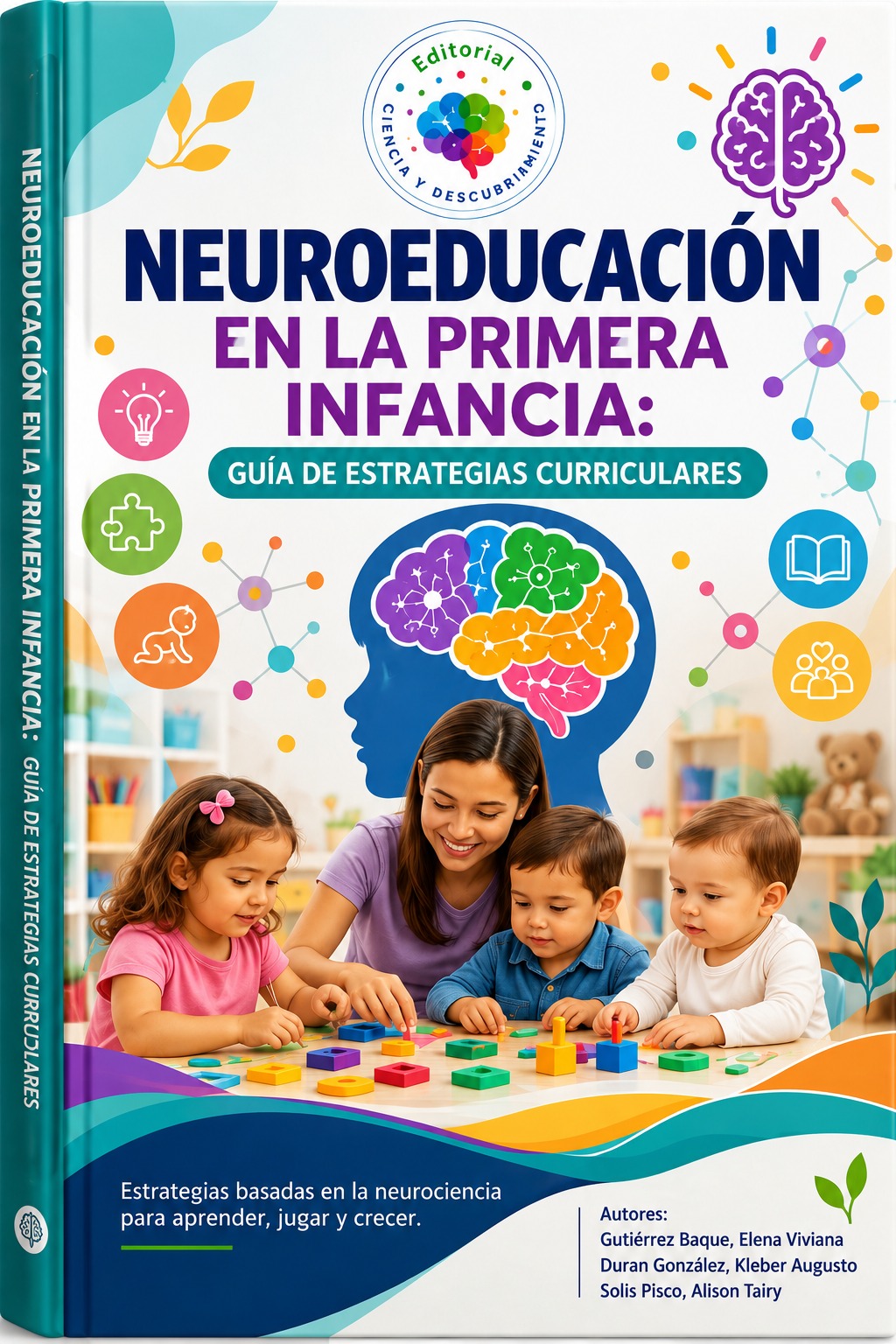
NEUROEDUCACIÓN EN LA PRIMERA INFANCIA
GUÍA DE ESTRATEGIAS CURRICULARES
DOI:
https://doi.org/10.63816/rnc46r89Palabras clave:
Neuroeducación , Primera infancia , Estrategias curriculares , Desarrollo cerebral , Funciones ejecutivasResumen
-
Esta obra aborda la integración de la neurociencia, la psicología y la pedagogía en el ámbito de la Educación Inicial, ofreciendo una guía práctica para enriquecer la planificación curricular desde una comprensión científica del desarrollo cerebral infantil.
-
El libro profundiza en los fundamentos neurocognitivos del aprendizaje en los primeros años de vida, analizando factores clave como la plasticidad cerebral, la atención, la memoria, las funciones ejecutivas y el rol determinante de la seguridad emocional y los vínculos afectivos.
-
Asimismo, traslada estos principios al diseño curricular activo a través del juego, la exploración multisensorial, el movimiento, la música y la narración, en ambientes estimulantes y seguros.
-
Finalmente, propone un enfoque inclusivo enfocado en la neurodiversidad, la eliminación de barreras para el aprendizaje, la corresponsabilidad familiar y una evaluación formativa basada en la observación y el acompañamiento pedagógico respetuoso.
Referencias
Alotaibi, M. S. (2024). Game-based learning in early childhood education: A systematic review and meta-analysis. Frontiers in Psychology, 15, 1307881. https://doi.org/10.3389/fpsyg.2024.1307881 DOI: https://doi.org/10.3389/fpsyg.2024.1307881
Bautista, G. F., Ghesquière, P., & Torbeyns, J. (2024). Stimulating preschoolers’ early literacy development using educational technology: A systematic literature review. International Journal of Child-Computer Interaction, 39, 100620. https://doi.org/10.1016/j.ijcci.2023.100620 DOI: https://doi.org/10.1016/j.ijcci.2023.100620
Bedoya Salazar, D. M., Mazuera Quiceno, C. A., & Arteaga, Á. P. (2024). Programa pedagógico basado en juegos sociomotrices para el desarrollo de las funciones ejecutivas en preescolares. Retos, 54, 715–720. https://doi.org/10.47197/retos.v54.100575 DOI: https://doi.org/10.47197/retos.v54.100575
Caballero-Julia, D., Martín-Lucas, J., & Andrade-Silva, L. E. (2024). Unpacking the relationship between screen use and educational outcomes in childhood: A systematic literature review. Computers & Education, 215, 105049. https://doi.org/10.1016/j.compedu.2024.105049 DOI: https://doi.org/10.1016/j.compedu.2024.105049
Camacho Marín, R. J., Colcha Pérez, J. R., & Cadena Heredia, V. F. (2026a). Revolución neurocognitiva: Desbloqueando el poder oculto de la mente. Editorial Ciencia y Descubrimiento. https://doi.org/10.63816/n3ks7p94 DOI: https://doi.org/10.63816/n3ks7p94
Camacho Marín, R. J., Espada Leyton, X. G., Paravicini Zarate, C. E., & Delgado Herrera, E. G. (2026b). Neuropedagogía digital: El nuevo mapa del aprendizaje humano. Editorial Ciencia y Descubrimiento. https://doi.org/10.63816/b89sqx78 DOI: https://doi.org/10.63816/b89sqx78
Center on the Developing Child at Harvard University. (2022). Brain-building through play: Activities for infants, toddlers, and children. https://developingchild.harvard.edu/topic/play/
Center on the Developing Child at Harvard University. (2024). A guide to executive function. https://developingchild.harvard.edu/topic/executive-function/
Chu, C., Paatsch, L., Kervin, L., & Edwards, S. (2024). Digital play in the early years: A systematic review. International Journal of Child-Computer Interaction, 40, 100652. https://doi.org/10.1016/j.ijcci.2024.100652 DOI: https://doi.org/10.1016/j.ijcci.2024.100652
Dereli, F., & Türk Kurtça, T. (2023). Family engagement in early childhood education: A phenomenological study. International Journal of Psychology and Educational Studies, 10(3), 714–732. https://doi.org/10.52380/ijpes.2023.10.3.1232 DOI: https://doi.org/10.52380/ijpes.2023.10.3.1232
Duncan, A. F., et al. (2024). Interventions to improve executive functions in children aged 3 years and under: A systematic review. Child: Care, Health and Development, 50(4), e13298. https://doi.org/10.1111/cch.13298 DOI: https://doi.org/10.1111/cch.13298
Fondo de las Naciones Unidas para la Infancia. (2024a). Logros de UNICEF Ecuador en 2024. https://www.unicef.org/ecuador/logros-de-unicef-ecuador-en-2024
Fondo de las Naciones Unidas para la Infancia. (2024b). Política Metropolitana de Primera Infancia. https://www.unicef.org/ecuador/informes/pol%C3%ADtica-metropolitana-de-primera-infancia
Gibbard, D., et al. (2024). A randomised controlled trial of the effectiveness of parent-based models of language intervention for 2- to 3-year-old children with speech, language and communication needs in areas of social disadvantage. International Journal of Language & Communication Disorders, 59(4), 1517–1537. https://doi.org/10.1111/1460-6984.13016 DOI: https://doi.org/10.1111/1460-6984.13016
Levickis, P., Murray, L., Lee-Pang, L., Eadie, P., Page, J., & Lee, W. Y. (2023). Parents’ perspectives of family engagement with early childhood education and care during the COVID-19 pandemic. Early Childhood Education Journal, 51, 1279–1289. https://doi.org/10.1007/s10643-022-01376-5 DOI: https://doi.org/10.1007/s10643-022-01376-5
Lewis, H. R., Lipscomb, S. T., Hatfield, B. E., Weber, R., Green, B., & Patterson, L. (2023). Family–teacher relationships and child engagement in early care and education. Societies, 13(3), 67. https://doi.org/10.3390/soc13030067 DOI: https://doi.org/10.3390/soc13030067
Llatance Ruiz, I. D. P., Ruiz Celi, R. D., Vicuña Peri, L. A., Rodríguez Vega, J. L., & Esteban Espinoza, D. (2024). Neuroeducación infantil temprana: Integrando la neurociencia al proceso de aprendizaje en la primera infancia: Una revisión sistemática. Educa-UMCH, (24), 78–93. https://doi.org/10.35756/educaumch.202424.294 DOI: https://doi.org/10.35756/educaumch.202424.294
Lu, Y., Shi, L., & Musib, A. F. (2025). Effects of music training on executive functions in preschool children aged 3–6 years: Systematic review and meta-analysis. Frontiers in Psychology, 15, 1522962. https://doi.org/10.3389/fpsyg.2024.1522962 DOI: https://doi.org/10.3389/fpsyg.2024.1522962
Macrides, E., Miliou, O., & Angeli, C. (2022). Programming in early childhood education: A systematic review. International Journal of Child-Computer Interaction, 32, 100396. https://doi.org/10.1016/j.ijcci.2021.100396 DOI: https://doi.org/10.1016/j.ijcci.2021.100396
McCarthy, C. (2023, 2 de febrero). Why play? Early games build bonds and brain. Harvard Health Publishing. https://www.health.harvard.edu/blog/why-play-early-games-build-bonds-and-brain-202302022884
Moffett, L., Weiland, C., McCormick, M. P., Hsueh, J., Snow, C., & Sachs, J. (2024). Off-task behavior as a measure of in-classroom executive function skills? Evidence for construct validity and contributions to gains in prekindergartners’ academic achievement. Early Education and Development, 35(4), 667–690. DOI: https://doi.org/10.1080/10409289.2023.2199658
Nagelhout, R. (2025, 14 de enero). Play helps children build better brains: Here are some ways to get kids learning. Harvard Graduate School of Education. https://www.gse.harvard.edu/ideas/usable-knowledge/25/01/play-helps-children-build-better-brains-here-are-some-ways-get-kids
Pérez-Marfil, M. N., Fernández-Alcántara, M., López-Benítez, R., Pérez-García, M., Pérez-García, M. P., & Cruz-Quintana, F. (2024). Effects of an executive function programme (PEFEN) on preschool children: A pilot study. Infancia y Aprendizaje, 47(1), 113–137. https://doi.org/10.1177/02103702231224641 DOI: https://doi.org/10.1177/02103702231224641
Rodriguez-Gomez, D. A., & Talero-Gutiérrez, C. (2022). Effects of music training in executive function performance in children: A systematic review. Frontiers in Psychology, 13, 968144. https://doi.org/10.3389/fpsyg.2022.968144 DOI: https://doi.org/10.3389/fpsyg.2022.968144
Sagñay Illapa, B. E. (2024). La neurodidáctica y su impacto en el desarrollo infantil. Universidad, Ciencia y Tecnología, 28(125), 88–96. https://doi.org/10.47460/uct.v28i125.858 DOI: https://doi.org/10.47460/uct.v28i125.858
Skene, K., O’Farrelly, C., Byrne, E. M., Kirby, N., Stevens, E. C., & Ramchandani, P. G. (2022). Can guidance during play enhance children’s learning and development in educational contexts? A systematic review and meta-analysis. Child Development, 93(4), 1162–1180. https://doi.org/10.1111/cdev.13730 DOI: https://doi.org/10.1111/cdev.13730
Swider-Cios, E., Vermeij, A., & Sitskoorn, M. M. (2023). Young children and screen-based media: The impact on cognitive and socioemotional development and the importance of parental mediation. Cognitive Development, 66, 101319. https://doi.org/10.1016/j.cogdev.2023.101319 DOI: https://doi.org/10.1016/j.cogdev.2023.101319
Taylor, G., Sala, G., Kolak, J., Gerhardstein, P., & Lingwood, J. (2024). Does adult-child co-use during digital media use improve children’s learning aged 0–6 years? A systematic review with meta-analysis. Educational Research Review, 44, 100614. https://doi.org/10.1016/j.edurev.2024.100614 DOI: https://doi.org/10.1016/j.edurev.2024.100614
Taylor, K., Neild, R., & Fitzpatrick, M. (2023). Universal design for learning: Promoting access in early childhood education for deaf and hard of hearing children. Perspectives on Early Childhood Psychology and Education, 5(2), Article 4. https://doi.org/10.58948/2834-8257.1059 DOI: https://doi.org/10.58948/2834-8257.1059
Vega-Fernandez, G., et al. (2026). Early childhood movement- and arts-based experiences and executive functions: A systematic review and meta-analysis. Children, 13(9), 1134. https://doi.org/10.3390/children13091134 DOI: https://doi.org/10.3390/children13091134
Walsh, K., L’Estrange, L., Smith, R., Burr, T., & Williams, K. E. (2024). Translating neuroscience to early childhood education: A scoping review of neuroscience-based professional learning for early childhood educators. Educational Research Review, 45, 100644. https://doi.org/10.1016/j.edurev.2024.100644 DOI: https://doi.org/10.1016/j.edurev.2024.100644
Zhang, J., et al. (2024). Recreational gymnastics exercise of moderate intensity enhances executive function in Chinese preschoolers: A randomized controlled trial. PsyCh Journal, 13(6), 954–965. https://doi.org/10.1002/pchj.786 DOI: https://doi.org/10.1002/pchj.786
Descargas
Publicado
Número
Sección
Licencia
Derechos de autor 2026 Gutiérrez Baque Elena Viviana, Duran González Kleber Augusto, Solis Pisco Alison Tairy (Autor/a)

Esta obra está bajo una licencia internacional Creative Commons Atribución-NoComercial-CompartirIgual 4.0.
Esta obra está bajo una licencia internacional Creative Commons Atribución-Compartir Igual 4.0.
Los autores/as que publiquen en esta revista aceptan las siguientes condiciones:
- Los autores conservan todos los derechos morales y patrimoniales de sus obras, cediendo solamente a la AJRPT el derecho a la primera publicación de éste. En consecuencia, los autores pueden realizar otros acuerdos contractuales independientes y adicionales para la distribución del artículo o texto.
- Los autores/as conservarán sus derechos de autor y aceptan la licencia de distribución de AJRPT, la cuál es Licencia de Reconocimiento - Compartir Igual Creative Commons.
- Los autores/as pueden realizar otros acuerdos contractuales independientes y adicionales para la distribución de la versión del artículo publicado en esta revista (p. ej., incluirlo en un repositorio institucional o publicarlo en un libro) siempre que indiquen claramente que el trabajo se publicó por primera vez en esta revista.
- Se permite y recomienda a los autores/as a publicar su trabajo en Internet (por ejemplo, en páginas institucionales o personales) sólo una vez que sean publicados en la revista AJRPT, ya que puede conducir a intercambios productivos y a una mayor y más rápida difusión.
Cómo citar