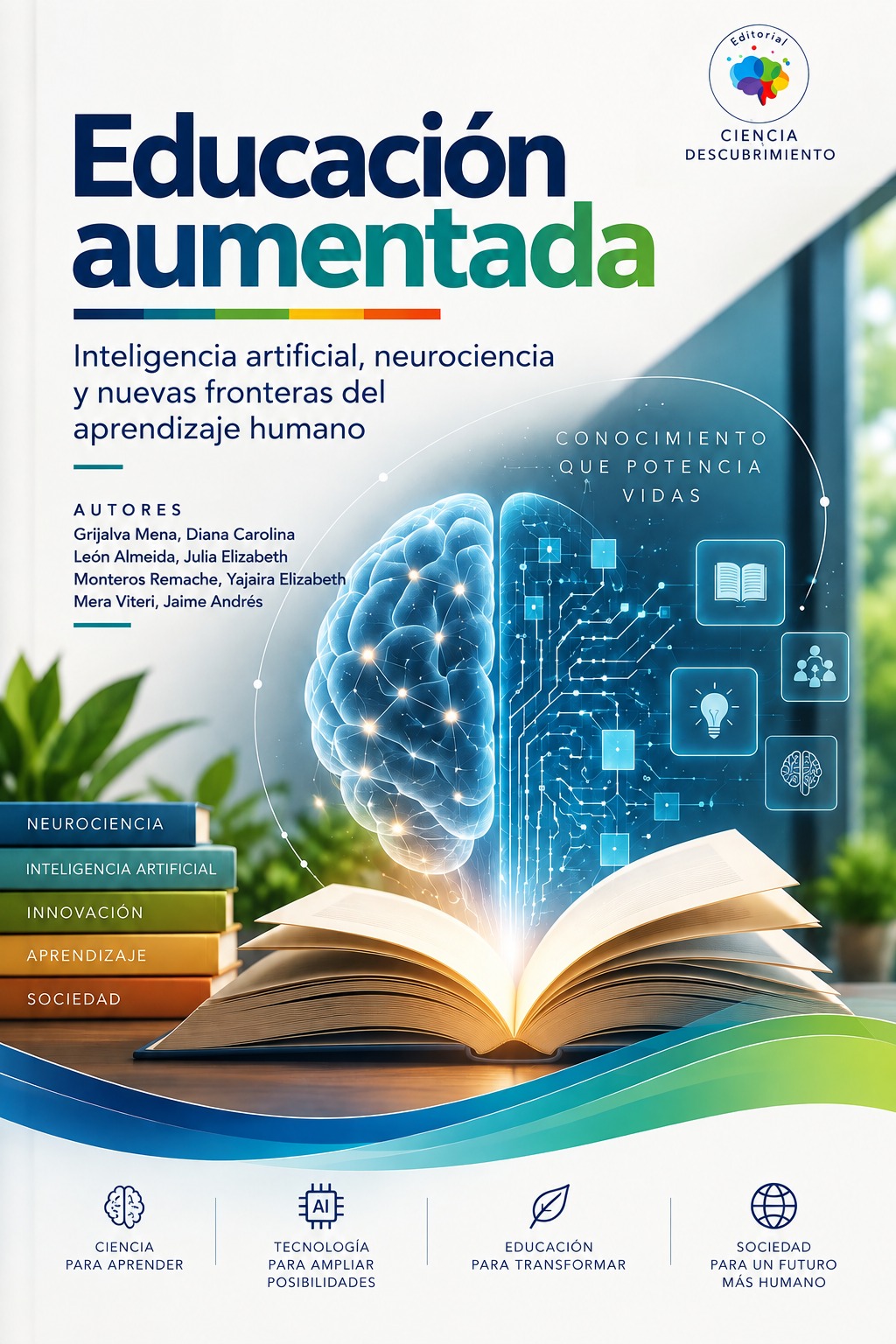
Educación aumentada
Inteligencia artificial, neurociencia y nuevas fronteras del aprendizaje humano
DOI:
https://doi.org/10.63816/hm0cw931Palabras clave:
Educación aumentada , Inteligencia artificial generativa , Neurociencia educativa , Descarga cognitiva , Personalización del aprendizajeResumen
Educación aumentada: Inteligencia artificial, neurociencia y nuevas fronteras del aprendizaje humano aborda la transformación del paradigma educativo contemporáneo producto de la convergencia entre tecnologías inteligentes, neurociencia y pedagogía. La obra propone el concepto de "educación aumentada" como un enfoque humanista centrado en amplificar las capacidades cognitivas, creativas y autorreguladoras de estudiantes y docentes, evitando la automatización indiscriminada y la dependencia tecnológica. A lo largo de sus tres capítulos, examina la evolución de los ecosistemas digitales hacia entornos adaptativos e inmersivos, el funcionamiento del cerebro en ambientes digitalizados (analizando neuroplasticidad, atención, funciones ejecutivas y neuroética), y la configuración de nuevas fronteras pedagógicas orientadas al aprendizaje basado en retos, la evaluación formativa y el humanismo digital.
Referencias
Ahn, M., et al. (2025). Cognitive frontiers: Neurotechnology and global internet governance. Frontiers in Digital Health. https://doi.org/10.3389/fdgth.2025.1690489
Alfredo, R., Echeverria, V., Jin, Y., Yan, L., Swiecki, Z., Gašević, D., & Martinez-Maldonado, R. (2024). Human-centred learning analytics and AI in education: A systematic literature review. Computers and Education: Artificial Intelligence, 6, 100215. https://doi.org/10.1016/j.caeai.2024.100215
Alipoor, J., & Pourrashidi, H. (2024). A critical study on the researches about the application of neurotechnology in education. International Journal of Neuroscience, 135(4), 496–503. https://doi.org/10.1080/00207454.2024.2311231
Archambault, S. G., Ramachandran, S., Acosta, E., & Fu, S. (2024). Ethical dimensions of algorithmic literacy for college students: Case studies and cross-disciplinary connections. The Journal of Academic Librarianship, 50(3), 102865. https://doi.org/10.1016/j.acalib.2024.102865
Atchley, P., Pannell, H., Wofford, K., Hopkins, M., & Atchley, R. A. (2024). Human and AI collaboration in the higher education environment: Opportunities and concerns. Cognitive Research: Principles and Implications, 9, 20. https://doi.org/10.1186/s41235-024-00547-9
Bal, M., Kara Aydemir, A. G., & Tepetaş Cengiz, G. Ş. (2024). Examining the relationship between language development, executive function, and screen time: A systematic review. PLOS ONE, 19(12), e0314540. https://doi.org/10.1371/journal.pone.0314540
Basumatary, D., & Maity, R. (2023). Effects of augmented reality in primary education: A literature review. Human Behavior and Emerging Technologies, 2023, 4695759. https://doi.org/10.1155/2023/4695759
Bayly-Castaneda, K., Ramirez-Montoya, M. S., & Morita-Alexander, A. (2024). Crafting personalized learning paths with AI for lifelong learning: A systematic literature review. Frontiers in Education, 9, 1424386. https://doi.org/10.3389/feduc.2024.1424386
Bond, M., Khosravi, H., De Laat, M., Bergdahl, N., Negrea, V., Oxley, E., Pham, P., Chong, S. W., & Siemens, G. (2024). A meta systematic review of artificial intelligence in higher education: A call for increased ethics, collaboration, and rigour. International Journal of Educational Technology in Higher Education, 21, 4. https://doi.org/10.1186/s41239-023-00436-z
Camacho Marín, R. J. (2025). Inteligencia artificial en el aula: Desafíos y oportunidades para la educación del siglo XXI. Revista Multidisciplinar Ciencia y Descubrimiento, 3(1). https://doi.org/10.63816/92rwmv16
Camacho Marín, R. J., Aguinsaca Hurtado, B. F., Chicaiza Llugcha, K. M., & Monar Suárez, M. A. (2024). El uso de tecnologías digitales en el aula: Evaluación de la eficacia de las plataformas de aprendizaje en el desarrollo de habilidades del siglo XXI en estudiantes de secundaria. Estudios y Perspectivas Revista Científica y Académica, 4(3), 1034–1054. https://doi.org/10.61384/r.c.a.v4i3.464
Camacho Marín, R. J., Angulo García, K. E., & Polanco Fajardo, M. (2026). Aprender sin límites: Reimaginando la educación del siglo XXI. Revista Multidisciplinar Ciencia y Descubrimiento, 4(3). https://doi.org/10.63816/qezjvk70
Camacho Marín, R. J., Belduma Rentería, L. A., Erazo Buenaño, J. S., Almeida García, E. V., & Tipán Chiguano, I. M. (2026). El futuro de la educación: Tendencias y estrategias para un aprendizaje eficiente. Revista Multidisciplinar Ciencia y Descubrimiento, 4(3). https://doi.org/10.63816/a7kfj877
Camacho Marín, R. J., Cadena Heredia, V., Murquincho Pinta, M. L., Pesantez Reyes, M. U., & Semanate Zapata, R. D. (2023). Proceso de calidad del sistema educativo en el Ecuador: Un análisis integral y prospectivo. Revista InveCom, 4(1), 1–16. https://doi.org/10.5281/zenodo.8310291
Camacho Marín, R. J., & Camacho Marín, R. A. (2026). Teoría del aprendizaje colaborativo y contextualizado (TACC): Un enfoque innovador para el desarrollo de habilidades en contextos reales. Revista Multidisciplinar Ciencia y Descubrimiento. https://doi.org/10.63816/5sa1zc51
Camacho Marín, R. J., Colcha Pérez, J. R., & Cadena Heredia, V. F. (2026). Revolución neurocognitiva: Desbloqueando el poder oculto de la mente. Editorial Ciencia y Descubrimiento. https://doi.org/10.63816/n3ks7p94
Camacho Marín, R. J., Espada Leyton, X. G., Paravicini Zarate, C. E., & Delgado Herrera, E. G. (2026). Neuropedagogía digital: El nuevo mapa del aprendizaje humano. Editorial Ciencia y Descubrimiento. https://doi.org/10.63816/b89sqx78
Camacho Marín, R. J., Linares Terán, I. Y., Cevallos Lozano, L. J., Semanate Zapata, R. D., & Castro González, A. E. (2024). Gerencia educativa: Estrategias innovadoras con las IA en el sistema educativo de Ecuador. Ciencia Latina Revista Científica Multidisciplinar, 8(4), 6134–6158. https://doi.org/10.37811/cl_rcm.v8i4.12817
Camacho Marín, R. J., & Primera Cuauro, D. J. (2026). Impacto de la inteligencia artificial generativa en el desarrollo de competencias digitales y pensamiento crítico en estudiantes del subnivel media general. Revista Multidisciplinar Ciencia y Descubrimiento, 4(2). https://doi.org/10.63816/sdz8b985
Casal-Otero, L., Catala, A., Fernández-Morante, C., Taboada, M., Cebreiro, B., & Barro, S. (2023). AI literacy in K-12: A systematic literature review. International Journal of STEM Education, 10, 29. https://doi.org/10.1186/s40594-023-00418-7
Chiu, T. K. F., et al. (2024). A scoping review on how generative artificial intelligence transforms assessment in higher education. International Journal of Educational Technology in Higher Education. https://doi.org/10.1186/s41239-024-00468-z
Coban, M., Bolat, Y. I., & Goksu, I. (2022). The potential of immersive virtual reality to enhance learning: A meta-analysis. Educational Research Review, 36, 100452. https://doi.org/10.1016/j.edurev.2022.100452
Crompton, H., & Burke, D. (2023). Artificial intelligence in higher education: The state of the field. International Journal of Educational Technology in Higher Education, 20, 22. https://doi.org/10.1186/s41239-023-00392-8
Dave, G. S. (2026). The illusion of learning: Generative AI and cognitive offloading in distance education. Quarterly Review of Distance Education, 1–13. https://doi.org/10.1108/QRDE-06-2026-0031
Doulougeri, K., Vermunt, J. D., Bombaerts, G., & Bots, M. (2024). Challenge-based learning implementation in engineering education: A systematic literature review. Journal of Engineering Education, 113(4), 1076–1106. https://doi.org/10.1002/jee.20588
Eaton, S. E. (2024). Future-proofing integrity in the age of artificial intelligence and neurotechnology: Prioritizing human rights, dignity, and equity. International Journal for Educational Integrity, 20, 21. https://doi.org/10.1007/s40979-024-00175-2
Effects of adaptive feedback generated by a large language model: A case study in teacher education. (2024). Computers and Education: Artificial Intelligence, 100349. https://doi.org/10.1016/j.caeai.2024.100349
Emerging technologies in higher education assessment and feedback practices: A systematic literature review. (2024). Journal of Systems and Software, 211, 111988. https://doi.org/10.1016/j.jss.2024.111988
Erat, K., Şahin, E. B., Doğan, F., & Merdanoğlu, N. (2024). Emotion recognition with EEG-based brain-computer interfaces: A systematic literature review. Multimedia Tools and Applications, 83, 79647–79694. https://doi.org/10.1007/s11042-024-18259-z
Franceschini, S., et al. (2024). Action video games normalise the phonemic awareness in pre-readers at risk for developmental dyslexia. npj Science of Learning, 9, 25. https://doi.org/10.1038/s41539-024-00230-0
Galdames-Calderón, M., Pedersen, A. S., & Rodriguez-Gomez, D. (2024). Systematic review: Revisiting challenge-based learning teaching practices in higher education. Education Sciences, 14(9), 1008. https://doi.org/10.3390/educsci14091008
Gandini, M. F., & Morselli, D. (2026). Challenge-based learning implementation in K-12 education: A systematic literature review. Frontiers in Education. https://doi.org/10.3389/feduc.2025.1680347
García-Martínez, I., Torres-Hernández, N., Espinosa-Fernández, I., & Checa-Domene, L. (2023). Mapeo sobre el uso de la neurotecnología en educación desde una perspectiva ética. Pixel-Bit. Revista de Medios y Educación, 68, 273–304. https://doi.org/10.12795/pixelbit.100461
Guo, H., Johnson, M., Ercikan, K., Saldivia, L., & Worthington, M. (2024). Large-scale assessments for learning: A human-centred AI approach to contextualizing test performance. Journal of Learning Analytics, 11(2), 229–245. https://doi.org/10.18608/jla.2024.8007
Gutiérrez Proenza, J. (2025). Neuroderechos y derechos humanos en la era de la neurotecnología: ¿Regulación necesaria o inevitable? Iuris Dictio, 36. https://doi.org/10.18272/iu.i36.3532
IEEE Brain. (2025). Education: Ethical issues. IEEE Brain Neuroethics Framework.
Iqbal, J., Hashmi, Z. F., Asghar, M. Z., & Abid, M. N. (2025). Generative AI tool use enhances academic achievement in sustainable education through shared metacognition and cognitive offloading among preservice teachers. Scientific Reports.
Kasneci, E., Sessler, K., Küchemann, S., Bannert, M., Dementieva, D., Fischer, F., Gasser, U., Groh, G., Günnemann, S., Hüllermeier, E., Krusche, S., Kutyniok, G., Michaeli, T., Nerdel, C., Pfeffer, J., Poquet, O., Sailer, M., Schmidt, A., Seidel, T., Stadler, M., Weller, J., Kuhn, J., & Kasneci, G. (2023). ChatGPT for good? On opportunities and challenges of large language models for education. Learning and Individual Differences, 103, 102274. https://doi.org/10.1016/j.lindif.2023.102274
Kestin, G., et al. (2024). Enhancing active learning through collaboration between human teachers and generative AI. Computers and Education Open, 6, 100183. https://doi.org/10.1016/j.caeo.2024.100183
Khalid, N., Kasbun, R., & Ab Rahman, N. F. (2026). Efficiency, engagement, and cognitive offloading: A review of generative AI in education. International Journal of Education, Psychology and Counselling. https://doi.org/10.35631/IJEPC.1162072
Lee, S. S., & Moore, R. L. (2024). Harnessing generative AI (GenAI) for automated feedback in higher education: A systematic review. Online Learning, 28(3). https://doi.org/10.24059/olj.v28i3.4593
Li, P., Legault, J., & Litcofsky, K. A. (2014). Neuroplasticity as a function of second language learning: Anatomical changes in the human brain. Cortex, 58, 301–324. https://doi.org/10.1016/j.cortex.2014.05.001
Liu, Y., Huang, S., Xu, W., Wang, Z., et al. (2024). An fMRI study on the generalization of motor learning after brain actuated supernumerary robot training. npj Science of Learning, 9, 80. https://doi.org/10.1038/s41539-024-00294-y
Miao, F., & Cukurova, M. (2024). AI competency framework for teachers. UNESCO. https://doi.org/10.54675/ZJTE2084
Miao, F., Shiohira, K., & Lao, N. (2024). AI competency framework for students. UNESCO.
Nakamura, D. (2026). Augmentation or erosion? Regulating cognitive offloading in generative AI-supported STEM learning. Educational Psychology Review, 38, 124. https://doi.org/10.1007/s10648-026-10224-6
Navarrete-Cazales, Z., Cruz-Victoria, J. C., & Manzanilla-Granados, H. M. (2026). Autoría e integridad académica ante la inteligencia artificial generativa en educación superior. Educación Superior y Sociedad, 37(2). https://doi.org/10.54674/ess.v37i2.1174
OECD. (2023). OECD Digital Education Outlook 2023: Towards an effective digital education ecosystem. OECD Publishing. https://doi.org/10.1787/c74f03de-en
OECD. (2025). What should teachers teach and students learn in a future of powerful AI? OECD Education Spotlights, No. 20. OECD Publishing. https://doi.org/10.1787/ca56c7d6-en
Ouyang, F., Zheng, L., & Jiao, P. (2022). Artificial intelligence in online higher education: A systematic review of empirical research from 2011 to 2020. Education and Information Technologies, 27, 7893–7925. https://doi.org/10.1007/s10639-022-10925-9
Rojas-Sánchez, M. A., Palos-Sánchez, P. R., & Folgado-Fernández, J. A. (2023). Systematic literature review and bibliometric analysis on virtual reality and education. Education and Information Technologies, 28, 155–192. https://doi.org/10.1007/s10639-022-11167-5
Roy, B. K., & Jony, M. S. (2026). Generative AI and critical thinking in higher education: Students’ narratives of cognitive offloading. Journal of Interdisciplinary Studies in Education. https://doi.org/10.32674/jey59q25
Schalk, G., Brunner, P., Allison, B. Z., et al. (2024). Translation of neurotechnologies. Nature Reviews Bioengineering, 2, 637–652. https://doi.org/10.1038/s44222-024-00185-2
Seung, Y., & Basham, J. D. (2026). Cognitive offloading in the age of generative AI: What does it mean for students with learning disabilities? Journal of Learning Disabilities, 49(3). https://doi.org/10.1177/07319487261439132
Sperling, K., Stenberg, C.-J., McGrath, C., Åkerfeldt, A., Heintz, F., & Stenliden, L. (2024). In search of artificial intelligence (AI) literacy in teacher education: A scoping review. Computers and Education Open, 6, 100169. https://doi.org/10.1016/j.caeo.2024.100169
Tlili, A., Shehata, B., Adarkwah, M. A., Bozkurt, A., Hickey, D. T., Huang, R., & Agyemang, B. (2023). What if the devil is my guardian angel: ChatGPT as a case study of using chatbots in education. Smart Learning Environments, 10, 15. https://doi.org/10.1186/s40561-023-00237-x
UNESCO. (2023). Guidance for generative AI in education and research. UNESCO. https://doi.org/10.54675/EWZM9535
UNESCO. (2024). Global education monitoring report 2023: Technology in education: A tool on whose terms? UNESCO. https://doi.org/10.54676/NEDS2300
UNESCO. (2025). Recommendation on the ethics of neurotechnology. UNESCO.
Villena-Taranilla, R., Tirado-Olivares, S., Cózar-Gutiérrez, R., & González-Calero, J. A. (2022). Effects of virtual reality on learning outcomes in K-6 education: A meta-analysis. Educational Research Review, 35, 100434. https://doi.org/10.1016/j.edurev.2022.100434
Yu, Z., & Xu, W. (2022). A meta-analysis and systematic review of the effect of virtual reality technology on users’ learning outcomes. Computer Applications in Engineering Education, 30(5), 1470–1484. https://doi.org/10.1002/cae.22532
Descargas
Publicado
Número
Sección
Licencia
Derechos de autor 2026 Grijalva Mena Diana Carolina, León Almeida Julia Elizabeth, Monteros Remache Yajaira Elizabeth, Mera Viteri Jaime Andrés (Autor/a)

Esta obra está bajo una licencia internacional Creative Commons Atribución-NoComercial-CompartirIgual 4.0.
Esta obra está bajo una licencia internacional Creative Commons Atribución-Compartir Igual 4.0.
Los autores/as que publiquen en esta revista aceptan las siguientes condiciones:
- Los autores conservan todos los derechos morales y patrimoniales de sus obras, cediendo solamente a la AJRPT el derecho a la primera publicación de éste. En consecuencia, los autores pueden realizar otros acuerdos contractuales independientes y adicionales para la distribución del artículo o texto.
- Los autores/as conservarán sus derechos de autor y aceptan la licencia de distribución de AJRPT, la cuál es Licencia de Reconocimiento - Compartir Igual Creative Commons.
- Los autores/as pueden realizar otros acuerdos contractuales independientes y adicionales para la distribución de la versión del artículo publicado en esta revista (p. ej., incluirlo en un repositorio institucional o publicarlo en un libro) siempre que indiquen claramente que el trabajo se publicó por primera vez en esta revista.
- Se permite y recomienda a los autores/as a publicar su trabajo en Internet (por ejemplo, en páginas institucionales o personales) sólo una vez que sean publicados en la revista AJRPT, ya que puede conducir a intercambios productivos y a una mayor y más rápida difusión.
Cómo citar