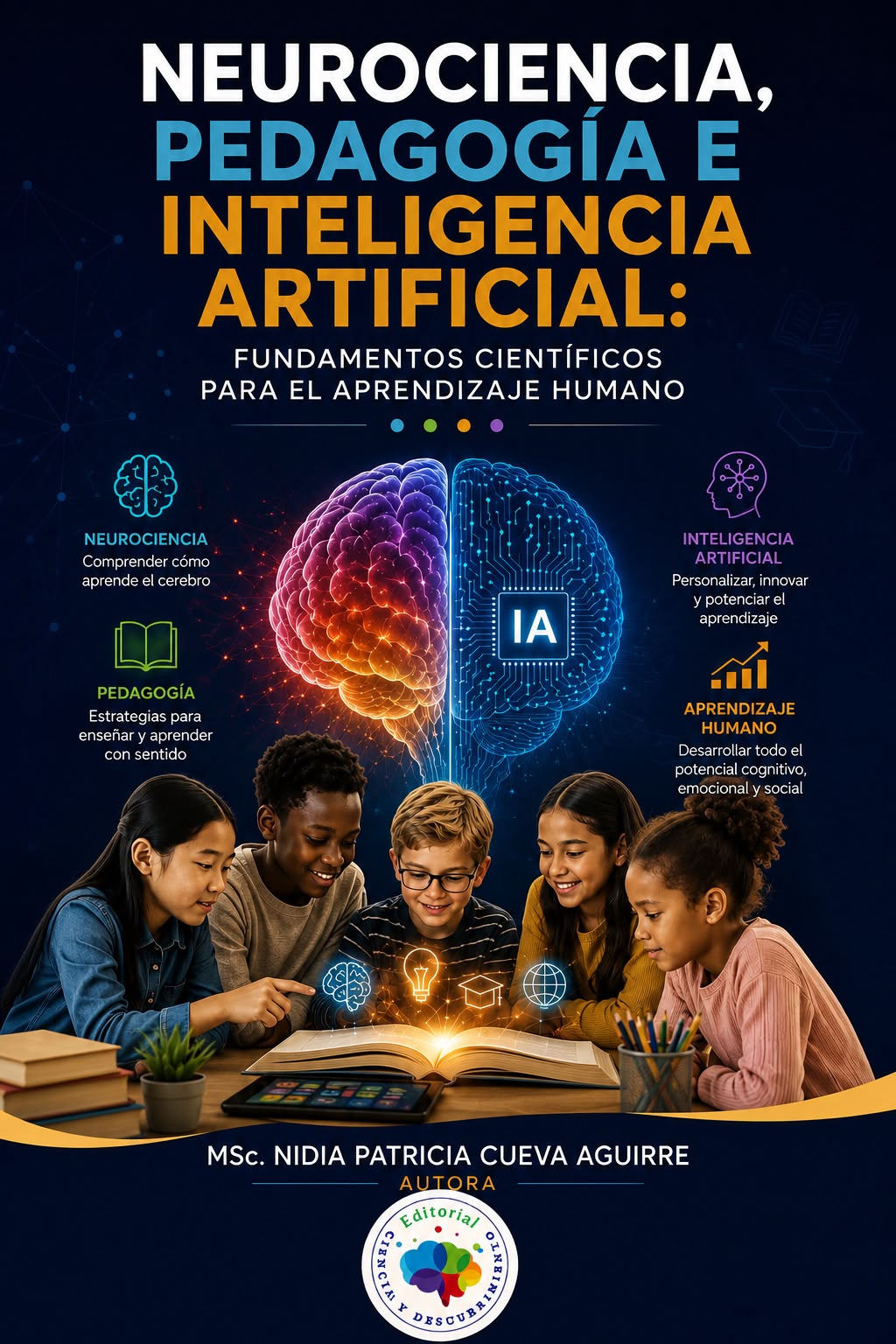
Neurociencia, Pedagogía e Inteligencia Artificial
Fundamentos científicos para el aprendizaje humano
DOI:
https://doi.org/10.63816/abyexe75Palabras clave:
Neurociencia educativa, Inteligencia artificial, Pedagogía, Aprendizaje personalizado, NeuroplasticidadResumen
Este libro propone el Modelo Integral de Neuroeducación Inteligente para el Aprendizaje Personalizado (MINDAP), un paradigma educativo fundamentado en la convergencia entre la neurociencia, la pedagogía basada en evidencia y la inteligencia artificial. A partir de la premisa de que la diversidad neurocognitiva de los estudiantes exige superar los enfoques homogéneos de enseñanza tradicional, la obra articula una propuesta estructurada en el diagnóstico multidimensional del aprendiz (a nivel cognitivo, emocional, motivacional y digital), el diseño de estrategias neuropedagógicas personalizadas mediante la adaptación del currículo y las metodologías, y la aplicación ética de la IA mediante tutores inteligentes, agentes conversacionales, analítica predictiva y retroalimentación neuroadaptativa.
Referencias
Alfredo, R., Echeverria, V., Jin, Y., Yan, L., Swiecki, Z., Gašević, D., & Martinez-Maldonado, R. (2024). Human-centred learning analytics and AI in education: A systematic literature review. Computers and Education: Artificial Intelligence, 6, 100215. https://doi.org/10.1016/j.caeai.2024.100215 DOI: https://doi.org/10.1016/j.caeai.2024.100215
Aljemely, A. S. (2024). Challenges and best practices in training teachers to utilize artificial intelligence: A systematic review. Frontiers in Education, 9. https://doi.org/10.3389/feduc.2024.1470853 DOI: https://doi.org/10.3389/feduc.2024.1470853
Alotaibi, M. S. (2024). Game-based learning in early childhood education: A systematic review and meta-analysis. Frontiers in Psychology, 15, 1307881. https://doi.org/10.3389/fpsyg.2024.1307881 DOI: https://doi.org/10.3389/fpsyg.2024.1307881
Antonopoulou, H., & Halkiopoulos, C. (2024). The Intersection of Emotional Neuroscience and Learning: A Comprehensive Review of Current Research. Technium BioChemMed, 11, 62–77. https://doi.org/10.47577/biochemmed.v11i.11975 DOI: https://doi.org/10.47577/biochemmed.v11i.11975
Bayly-Castaneda, K., Ramírez-Montoya, M. S., & Morita-Alexander, A. (2024). Crafting personalized learning paths with AI for lifelong learning: A systematic literature review. Frontiers in Education, 9, 1424386. https://doi.org/10.3389/feduc.2024.1424386 DOI: https://doi.org/10.3389/feduc.2024.1424386
Black, P., & Wiliam, D. (2009). Developing the theory of formative assessment. Educational Assessment, Evaluation and Accountability, 21(1), 5–31. https://doi.org/10.1007/s11092-008-9068-5 DOI: https://doi.org/10.1007/s11092-008-9068-5
Bond, M., Crompton, H., & Kimmons, R. (2023). Artificial intelligence and accessibility in education: A systematic review. International Journal of Educational Technology in Higher Education, 20, 52. https://doi.org/10.1186/s41239-023-00408-3 DOI: https://doi.org/10.1186/s41239-023-00392-8
Brown, P. C., Roediger, H. L., & McDaniel, M. A. (2022). Make It Stick: The Science of Successful Learning (Edición revisada). Harvard University Press.
Burbano-Enríquez, B., Moncayo-Cueva, H., & Andrade-Zuleta, A. (2025). Neuroeducation and the influence of AI on early childhood education: A systematic review. Multidisciplinary Reviews, 9, e2026238. https://doi.org/10.31893/multirev.2026238 DOI: https://doi.org/10.31893/multirev.2026238
CAST. (2024). Universal Design for Learning Guidelines 3.0. https://udlguidelines.cast.org
Center on the Developing Child at Harvard University. (2023). Brain Architecture. https://developingchild.harvard.edu
Center on the Developing Child at Harvard University. (s. f.). Serve and Return: Back-and-Forth Exchanges. Harvard University.
Chi, M. T. H., & Wylie, R. (2014). The ICAP framework: Linking cognitive engagement to active learning outcomes. Educational Psychologist, 49(4), 219–243. https://doi.org/10.1080/00461520.2014.965823 DOI: https://doi.org/10.1080/00461520.2014.965823
Claro, M., Salinas, Á., Cabello-Hutt, T., San Martín, E., Preiss, D. D., Valenzuela, S., & Jara, I. (2024). A systematic review of quantitative research on teachers' digital competence. Computers & Education, 211, 104982. https://doi.org/10.1016/j.compedu.2024.104982
Crompton, H., & Burke, D. (2023). Artificial intelligence in higher education: The state of the field. International Journal of Educational Technology in Higher Education, 20, 22. https://doi.org/10.1186/s41239-023-00392-8 DOI: https://doi.org/10.1186/s41239-023-00392-8
Darling-Hammond, L., Flook, L., Cook-Harvey, C., Barron, B., & Osher, D. (2024). Implications for Educational Practice of the Science of Learning and Development. Applied Developmental Science. https://doi.org/10.1080/10888691.2024.2332477
Das, S., & Karmakar, S. (2026). Impact of Neuroeducation on Teaching Learning Process. En D. Elomari et al. (Eds.), Cutting-Edge Strategies and Applications of Neuropedagogy (pp. 303–332). IGI Global. https://doi.org/10.4018/979-8-3373-3581-0.ch011 DOI: https://doi.org/10.4018/979-8-3373-3581-0.ch011
Diamond, A. (2023). Executive Functions. Annual Review of Psychology, 74, 597–626. https://doi.org/10.1146/annurev-psych-032720-094327
Dörrenbächer-Ulrich, L., & Bregulla, M. (2024). The Relationship Between Self-Regulated Learning and Executive Functions—A Systematic Review. Educational Psychology Review, 36, 95. https://doi.org/10.1007/s10648-024-09932-8 DOI: https://doi.org/10.1007/s10648-024-09932-8
du Plooy, E., Casteleijn, D., & Franzsen, D. (2024). Personalized adaptive learning in higher education: A scoping review of key characteristics and impact on academic performance and engagement. Heliyon, 10(21), e39630. https://doi.org/10.1016/j.heliyon.2024.e39630 DOI: https://doi.org/10.1016/j.heliyon.2024.e39630
European Commission. (2022). The Digital Competence Framework for Citizens (DigComp 2.2): With New Examples of Knowledge, Skills and Attitudes. Publications Office of the European Union. https://doi.org/10.2760/115376
European Agency for Special Needs and Inclusive Education. (2023). Inclusive Education in Action: Policy and Practice.
Friedman, I. A., Grobgeld, E., & Teichman-Weinberg, A. (2026). Neuropedagogy: From neurons to teaching and learning. Frontiers in Education, 11, 1774900. https://doi.org/10.3389/feduc.2026.1774900 DOI: https://doi.org/10.3389/feduc.2026.1774900
González-Cabrera, J., Tourón, J., & Machimbarrena, J. M. (2024). Neuroplasticity and educational innovation: Implications for teaching and learning. Frontiers in Education, 9, 1452183. https://doi.org/10.3389/feduc.2024.1452183
Holmes, W., Bialik, M., & Fadel, C. (2022). Artificial Intelligence in Education: Promises and Implications for Teaching and Learning. Center for Curriculum Redesign. DOI: https://doi.org/10.58863/20.500.12424/4276068
Holmes, W., Tuomi, I., & Mavrikis, M. (2025). Artificial Intelligence and Cognitive Augmentation in Education: Opportunities, Challenges and Ethical Considerations. Computers and Education: Artificial Intelligence. https://doi.org/10.1016/j.caeai.2025.100353
Ifenthaler, D., & Schumacher, C. (2023). Learning Analytics and Artificial Intelligence in Education: Implications for Teaching and Learning. Technology, Knowledge and Learning. https://doi.org/10.1007/s10758-023-09662-0
Immordino-Yang, M. H., Darling-Hammond, L., & Krone, C. R. (2024). The Brain Basis for Integrated Social, Emotional, and Academic Development: How Emotions and Social Relationships Drive Learning. Aspen Institute.
Kasneci, E., et al. (2023). ChatGPT for good? On opportunities and challenges of large language models for education. Learning and Individual Differences, 103, 102274. https://doi.org/10.1016/j.lindif.2023.102274 DOI: https://doi.org/10.1016/j.lindif.2023.102274
Luckin, R. (2024). AI for Schoolteachers. Routledge.
Matricciani, L., Bin, Y. S., Lallukka, T., & Paquet, C. (2023). Children's sleep and health: A review of contemporary evidence. Sleep Medicine Reviews, 69, 101769. https://doi.org/10.1016/j.smrv.2023.101769 DOI: https://doi.org/10.1016/j.smrv.2023.101769
Mollick, E., & Mollick, L. (2024). Using AI to Implement Effective Teaching Strategies in Classrooms: Five Strategies, Including Prompts. SSRN. https://doi.org/10.2139/ssrn.4391243 DOI: https://doi.org/10.2139/ssrn.4391243
OECD. (2024). Education Policy Outlook 2024: Reshaping Teaching into a Thriving Profession from ABCs to AI. OECD Publishing. https://doi.org/10.1787/dd5140e4-en DOI: https://doi.org/10.1787/dd5140e4-en
OECD. (2025). OECD Digital Education Outlook 2025: Artificial Intelligence and the Future of Learning. OECD Publishing.
Palanci, A., Yılmaz, R. M., & Turan, Z. (2024). Learning analytics in distance education: A systematic review study. Education and Information Technologies, 29, 22629–22650. https://doi.org/10.1007/s10639-024-12737-5 DOI: https://doi.org/10.1007/s10639-024-12737-5
Pradeep, K., Sulur Anbalagan, R., Thangavelu, A. P., Aswathy, S., Jisha, V. G., & Vaisakhi, V. S. (2024). Neuroeducation: Understanding Neural Dynamics in Learning and Teaching. Frontiers in Education, 9, 1437418. https://doi.org/10.3389/feduc.2024.1437418 DOI: https://doi.org/10.3389/feduc.2024.1437418
Ryan, R. M., & Deci, E. L. (2024). Self-Determination Theory: Basic Psychological Needs in Motivation, Development, and Wellness (2nd ed.). Guilford Press.
Shiwlani, A., Hasan, S. U., & Kumar, S. (2024). Artificial Intelligence in Neuroeducation: A Systematic Review of AI Applications Aligned with Neuroscience Principles for Optimizing Learning Strategies. Journal of Development and Social Sciences, 5(4). https://doi.org/10.47205/jdss.2024(5-IV)50
Tinjacá Muñoz, M. A. (2025). El impacto de la neurociencia en la enseñanza y el aprendizaje: Evidencia de una revisión sistemática. Plumilla Educativa, 34(2), 1–23. https://doi.org/10.30554/pe.34.2.5150.2025 DOI: https://doi.org/10.30554/p.e.2.5150.2025
UNESCO. (2023). Guidance for Generative AI in Education and Research. https://doi.org/10.54675/EWZM9535 DOI: https://doi.org/10.54675/EWZM9535
UNESCO. (2024). AI Competency Framework for Teachers. https://unesdoc.unesco.org/ark:/48223/pf0000391104
UNESCO. (2024). AI Competency Framework for Students.
UNESCO. (2024). Global Education Monitoring Report 2024/25: Leadership in Education.
UNESCO. (2024). Harnessing the Era of Artificial Intelligence in Higher Education: A Primer for Higher Education Stakeholders.
UNESCO. (2024). Use of AI in Education: Deciding on the Future We Want.
UNICEF. (2024). Policy Guidance on AI for Children.
Vargas-Parra, M. A., & Castro-Rojas, D. (2024). Neurodiversity and inclusive education: Contemporary perspectives for personalized learning. Frontiers in Education, 9. https://doi.org/10.3389/feduc.2024.1450219
World Health Organization. (2024). Guidelines on Physical Activity, Sedentary Behaviour and Sleep for Children and Adolescents.
Zawacki-Richter, O., Bond, M., Bozkurt, A., & Marín, V. I. (2024). Artificial intelligence in higher education: A systematic literature review and research agenda. International Journal of Educational Technology in Higher Education. https://doi.org/10.1186/s41239-024-00478-2
Zimmerman, B. J. (2023). Becoming a Self-Regulated Learner: An Overview. En Educational Psychology Handbook.
Descargas
Publicado
Número
Sección
Licencia
Derechos de autor 2026 Msc. Cueva Aguirre Nidia Patricia (Autor/a)

Esta obra está bajo una licencia internacional Creative Commons Atribución-NoComercial-CompartirIgual 4.0.
Esta obra está bajo una licencia internacional Creative Commons Atribución-Compartir Igual 4.0.
Los autores/as que publiquen en esta revista aceptan las siguientes condiciones:
- Los autores conservan todos los derechos morales y patrimoniales de sus obras, cediendo solamente a la AJRPT el derecho a la primera publicación de éste. En consecuencia, los autores pueden realizar otros acuerdos contractuales independientes y adicionales para la distribución del artículo o texto.
- Los autores/as conservarán sus derechos de autor y aceptan la licencia de distribución de AJRPT, la cuál es Licencia de Reconocimiento - Compartir Igual Creative Commons.
- Los autores/as pueden realizar otros acuerdos contractuales independientes y adicionales para la distribución de la versión del artículo publicado en esta revista (p. ej., incluirlo en un repositorio institucional o publicarlo en un libro) siempre que indiquen claramente que el trabajo se publicó por primera vez en esta revista.
- Se permite y recomienda a los autores/as a publicar su trabajo en Internet (por ejemplo, en páginas institucionales o personales) sólo una vez que sean publicados en la revista AJRPT, ya que puede conducir a intercambios productivos y a una mayor y más rápida difusión.
Cómo citar