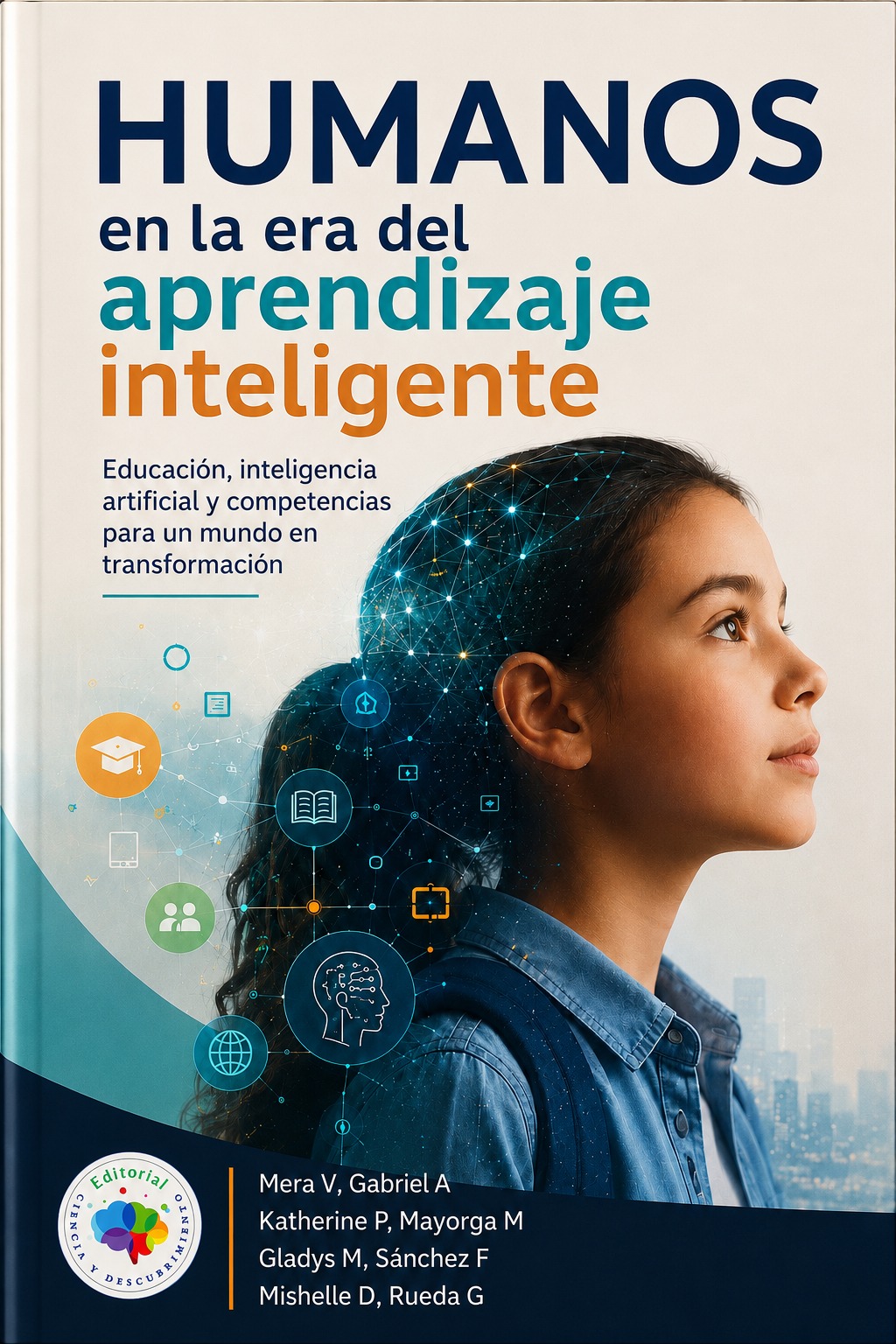
Humanos en la era del aprendizaje inteligente
Educación, inteligencia artificial y competencias para un mundo en transformación
DOI:
https://doi.org/10.63816/av5afr11Palabras clave:
Aprendizaje inteligente , Inteligencia artificial educativa , Competencias digitales , Ética tecnológica , Transformación educativaResumen
La obra "Humanos en la era del aprendizaje inteligente" explora la transformación profunda de la educación impulsada por la inteligencia artificial y las tecnologías digitales. El texto enfatiza la necesidad de mantener al ser humano en el centro del proceso formativo, promoviendo el desarrollo de competencias irremplazables como el pensamiento crítico, la creatividad, la alfabetización en inteligencia artificial y la inteligencia emocional. Asimismo, analiza la creación de ecosistemas educativos inteligentes, la personalización del aprendizaje y los desafíos éticos asociados (como la privacidad y los sesgos algorítmicos), con el propósito de preparar a los estudiantes y docentes para profesiones y sociedades en constante cambio.
Referencias
Albadarin, Y., Saqr, M., Pope, N., & Tukiainen, M. (2024). A systematic literature review of empirical research on ChatGPT in education. Discover Education, 3, 60. https://doi.org/10.1007/s44217-024-00138-2 DOI: https://doi.org/10.1007/s44217-024-00138-2
Aljemely, Y. (2024). Challenges and best practices in training teachers to utilize artificial intelligence: A systematic review. Frontiers in Education, 9, 1470853. https://doi.org/10.3389/feduc.2024.1470853 DOI: https://doi.org/10.3389/feduc.2024.1470853
An, Q., Yang, J., Xu, X., & Zhang, Y. (2024). Decoding AI ethics from users' lens in education: A systematic review. Heliyon, 10(20), e39357. https://doi.org/10.1016/j.heliyon.2024.e39357 DOI: https://doi.org/10.1016/j.heliyon.2024.e39357
Baig, M. I., & Yadegaridehkordi, E. (2024). ChatGPT in the higher education: A systematic literature review and research challenges. International Journal of Educational Research, 127, 102411. https://doi.org/10.1016/j.ijer.2024.102411 DOI: https://doi.org/10.1016/j.ijer.2024.102411
Bankins, S., Hu, X., & Yuan, Y. (2024). Artificial intelligence, workers, and future of work skills. Current Opinion in Psychology, 58, 101828. https://doi.org/10.1016/j.copsyc.2024.101828 DOI: https://doi.org/10.1016/j.copsyc.2024.101828
Bond, M., Khosravi, H., De Laat, M., Bergdahl, N., Negrea, V., Oxley, E., Pham, P., Chong, S. W., & Siemens, G. (2024). A meta systematic review of artificial intelligence in higher education: A call for increased ethics, collaboration, and rigour. International Journal of Educational Technology in Higher Education, 21, 4. https://doi.org/10.1186/s41239-023-00436-z DOI: https://doi.org/10.1186/s41239-023-00436-z
Brandão, A., Pedro, L., & Zagalo, N. (2024). Teacher professional development for a future with generative artificial intelligence: An integrative literature review. Digital Education Review, 45, 151–157. https://doi.org/10.1344/der.2024.45.151-157 DOI: https://doi.org/10.1344/der.2024.45.151-157
Cebreiro, B., Casal-Otero, L., Fernández-Morante, C., & Barro, S. (2023). AI literacy in K-12: A systematic literature review. International Journal of STEM Education, 10, 29. https://doi.org/10.1186/s40594-023-00418-7 DOI: https://doi.org/10.1186/s40594-023-00418-7
Chan, C. K. Y. (2023). A comprehensive AI policy education framework for university teaching and learning. International Journal of Educational Technology in Higher Education, 20, 38. https://doi.org/10.1186/s41239-023-00408-3 DOI: https://doi.org/10.1186/s41239-023-00408-3
Chen, J., Dai, J., Zhu, K., & Xu, L. (2022). Effects of extended reality on language learning: A meta-analysis. Frontiers in Psychology, 13, 1016519. https://doi.org/10.3389/fpsyg.2022.1016519 DOI: https://doi.org/10.3389/fpsyg.2022.1016519
Chiu, T. K. F., Xia, Q., Zhou, X., Chai, C. S., & Cheng, M. (2023). Systematic literature review on opportunities, challenges, and future research recommendations of artificial intelligence in education. Computers and Education: Artificial Intelligence, 4, 100118. https://doi.org/10.1016/j.caeai.2022.100118 DOI: https://doi.org/10.1016/j.caeai.2022.100118
Deng, R., Jiang, M., Yu, X., Lu, Y., & Liu, S. (2024). Does ChatGPT enhance student learning? A systematic review and meta-analysis of experimental studies. Computers & Education, 105224. https://doi.org/10.1016/j.compedu.2024.105224 DOI: https://doi.org/10.1016/j.compedu.2024.105224
Dimitriadou, E., & Lanitis, A. (2023). A critical evaluation, challenges, and future perspectives of using artificial intelligence and emerging technologies in smart classrooms. Smart Learning Environments, 10, 12. https://doi.org/10.1186/s40561-023-00231-3 DOI: https://doi.org/10.1186/s40561-023-00231-3
Dong, W., & Lu, J. (2023). An overview of applications and trends in the use of extended reality for teaching effectiveness: An umbrella review based on 20 meta-analysis studies. The Electronic Library, 41(5), 557–577. https://doi.org/10.1108/EL-11-2022-0257 DOI: https://doi.org/10.1108/EL-11-2022-0257
Fu, Y., & Weng, Z. (2024). Navigating the ethical terrain of AI in education: A systematic review on framing responsible human-centered AI practices. Computers and Education: Artificial Intelligence, 7, 100306. https://doi.org/10.1016/j.caeai.2024.100306 DOI: https://doi.org/10.1016/j.caeai.2024.100306
Hamlin, E. L. B., McGloin, R., & Bridgemohan, A. (2024). Communication skills training: A quantitative systematic review. Development and Learning in Organizations: An International Journal, 38(6), 18–22. https://doi.org/10.1108/DLO-08-2023-0188 DOI: https://doi.org/10.1108/DLO-08-2023-0188
He, G., Chen, S., Lin, H., et al. (2024). The association between initial metacognition and subsequent academic achievement: A meta-analysis of longitudinal studies. Educational Psychology Review, 36, 81. https://doi.org/10.1007/s10648-024-09922-w DOI: https://doi.org/10.1007/s10648-024-09922-w
Holzberger, D., Täschner, J., et al. (2023). Heterogeneity in the relationship between parental involvement and school outcomes: A systematic overview on current meta-analyses. Zeitschrift für Erziehungswissenschaft, 26, 105–140. https://doi.org/10.1007/s11618-022-01137-5 DOI: https://doi.org/10.1007/s11618-022-01137-5
Kasneci, E., Sessler, K., Küchemann, S., Bannert, M., Dementieva, D., Fischer, F., Gasser, U., Groh, G., Günnemann, S., Hüllermeier, E., Krusche, S., Kutyniok, G., Michaeli, T., Nerdel, C., Pfeffer, J., Poquet, O., Sailer, M., Schmidt, A., Seidel, T., Stadler, M., Weller, J., Kuhn, J., & Kasneci, G. (2023). ChatGPT for good? On opportunities and challenges of large language models for education. Learning and Individual Differences, 103, 102274. https://doi.org/10.1016/j.lindif.2023.102274 DOI: https://doi.org/10.1016/j.lindif.2023.102274
Kerimbayev, N., Umirzakova, Z., Shadiev, R., & Jotsov, V. (2023). A student-centered approach using modern technologies in distance learning: A systematic review of the literature. Smart Learning Environments, 10, 61. https://doi.org/10.1186/s40561-023-00280-8 DOI: https://doi.org/10.1186/s40561-023-00280-8
Lee, S. J., & Kwon, K. (2024). A systematic review of AI education in K-12 classrooms from 2018 to 2023: Topics, strategies, and learning outcomes. Computers and Education: Artificial Intelligence, 6, 100211. https://doi.org/10.1016/j.caeai.2024.100211 DOI: https://doi.org/10.1016/j.caeai.2024.100211
Li, L., Yu, F., & Zhang, E. (2024). A systematic review of learning task design for K-12 AI education: Trends, challenges, and opportunities. Computers and Education: Artificial Intelligence, 6, 100217. https://doi.org/10.1016/j.caeai.2024.100217 DOI: https://doi.org/10.1016/j.caeai.2024.100217
Li, Y., & Abdul Rahman, M. N. B. (2025). Parental involvement in digital learning during elementary school education: A systematic literature review. European Journal of Education, 60(3), e70186. https://doi.org/10.1111/ejed.70186 DOI: https://doi.org/10.1111/ejed.70186
Lin, C.-C., Huang, A. Y. Q., & Lu, O. H. T. (2023). Artificial intelligence in intelligent tutoring systems toward sustainable education: A systematic review. Smart Learning Environments, 10, 41. https://doi.org/10.1186/s40561-023-00260-y DOI: https://doi.org/10.1186/s40561-023-00260-y
Lintner, T. (2024). A systematic review of AI literacy scales. npj Science of Learning, 9, 50. https://doi.org/10.1038/s41539-024-00264-4 DOI: https://doi.org/10.1038/s41539-024-00264-4
Liu, J., Liu, Z., Wang, C., Li, Z., & Xu, Y. (2024). Can technology-based intervention improve collaboration skills: A meta-analysis study. Asia Pacific Journal of Education. https://doi.org/10.1080/02188791.2024.2389126 DOI: https://doi.org/10.1080/02188791.2024.2389126
Liu, X., & Zhong, B. (2024). A systematic review on how educators teach AI in K-12 education. Educational Research Review, 45, 100642. https://doi.org/10.1016/j.edurev.2024.100642 DOI: https://doi.org/10.1016/j.edurev.2024.100642
Memarian, B., & Doleck, T. (2024). Embodied AI in education: A review on the body, environment, and mind. Education and Information Technologies, 29, 895–916. https://doi.org/10.1007/s10639-023-12346-8 DOI: https://doi.org/10.1007/s10639-023-12346-8
Montenegro-Rueda, M., Fernández-Cerero, J., Fernández-Batanero, J. M., & López-Meneses, E. (2023). Impact of the implementation of ChatGPT in education: A systematic review. Computers, 12(8), 153. https://doi.org/10.3390/computers12080153 DOI: https://doi.org/10.3390/computers12080153
Mouta, A., Pinto-Llorente, A. M., & Torrecilla-Sánchez, E. M. (2024). Uncovering blind spots in education ethics: Insights from a systematic literature review on artificial intelligence in education. International Journal of Artificial Intelligence in Education, 34, 1166–1205. https://doi.org/10.1007/s40593-023-00384-9 DOI: https://doi.org/10.1007/s40593-023-00384-9
Ng, D. T. K., Leung, J. K. L., Su, J., Ng, R. C. W., & Chu, S. K. W. (2024). A systematic review of AI literacy conceptualization, constructs, and implementation and assessment efforts (2019–2023). Computers and Education Open, 6, 100173. https://doi.org/10.1016/j.caeo.2024.100173 DOI: https://doi.org/10.1016/j.caeo.2024.100173
Orih, D., Heyeres, M., Morgan, R., Udah, H., & Tsey, K. (2024). A systematic review of soft skills interventions within curricula from school to university level. Frontiers in Education, 9, 1383297. https://doi.org/10.3389/feduc.2024.1383297 DOI: https://doi.org/10.3389/feduc.2024.1383297
Pinski, M., & Benlian, A. (2024). AI literacy for users: A comprehensive review and future research directions of learning methods, components, and effects. Computers in Human Behavior: Artificial Humans, 2, 100062. https://doi.org/10.1016/j.chbah.2024.100062 DOI: https://doi.org/10.1016/j.chbah.2024.100062
Prinsloo, P. (2023). Multimodal learning analytics—In-between student privacy and encroachment: A systematic review. British Journal of Educational Technology. https://doi.org/10.1111/bjet.13373 DOI: https://doi.org/10.1111/bjet.13373
Quílez-Robres, A., Usán, P., Lozano-Blasco, R., & Salavera, C. (2023). Emotional intelligence and academic performance: A systematic review and meta-analysis. Thinking Skills and Creativity, 49, 101355. https://doi.org/10.1016/j.tsc.2023.101355 DOI: https://doi.org/10.1016/j.tsc.2023.101355
Raees, M., Meijerink, I., Lykourentzou, I., Khan, V.-J., & Papangelis, K. (2024). From explainable to interactive AI: A literature review on current trends in human-AI interaction. International Journal of Human-Computer Studies, 189, 103301. https://doi.org/10.1016/j.ijhcs.2024.103301 DOI: https://doi.org/10.1016/j.ijhcs.2024.103301
Schürmann, V., Marquardt, N., & Bodemer, D. (2024). Conceptualization and measurement of peer collaboration in higher education: A systematic review. Small Group Research, 55(1). https://doi.org/10.1177/10464964231200191 DOI: https://doi.org/10.1177/10464964231200191
Sethi, S. S., & Jain, K. (2024). AI technologies for social emotional learning: Recent research and future directions. Journal of Research in Innovative Teaching & Learning, 17(2), 213–225. https://doi.org/10.1108/JRIT-03-2024-0073 DOI: https://doi.org/10.1108/JRIT-03-2024-0073
Tadlaoui-Brahmi, A., Çuko, K., & Alvarez, L. (2022). Digital citizenship in primary education: A systematic literature review describing how it is implemented. Social Sciences & Humanities Open, 6(1), 100348. https://doi.org/10.1016/j.ssaho.2022.100348 DOI: https://doi.org/10.1016/j.ssaho.2022.100348
Tan, X., Cheng, K. S., & Ling, M. H. A. (2025). Artificial intelligence in teaching and teacher professional development: A systematic review. Computers and Education: Artificial Intelligence, 8, 100355. https://doi.org/10.1016/j.caeai.2024.100355 DOI: https://doi.org/10.1016/j.caeai.2024.100355
Thwe, W. P., & Kálmán, A. (2024). Lifelong learning in the educational setting: A systematic literature review. The Asia-Pacific Education Researcher, 33, 407–417. https://doi.org/10.1007/s40299-023-00738-w DOI: https://doi.org/10.1007/s40299-023-00738-w
Tlili, A., Shehata, B., Adarkwah, M. A., Bozkurt, A., Hickey, D. T., Huang, R., & Agyemang, B. (2023). What if the devil is my guardian angel: ChatGPT as a case study of using chatbots in education. Smart Learning Environments, 10, 15. https://doi.org/10.1186/s40561-023-00237-x DOI: https://doi.org/10.1186/s40561-023-00237-x
Van den Broeck, L., De Laet, T., Dujardin, R., Tuyaerts, S., & Langie, G. (2024). Unveiling the competencies at the core of lifelong learning: A systematic literature review. Educational Research Review, 45, 100646. https://doi.org/10.1016/j.edurev.2024.100646 DOI: https://doi.org/10.1016/j.edurev.2024.100646
Wang, C., Omar Dev, R. D., Soh, K. G., Mohd Nasirudddin, N. J., Yuan, Y., & Ji, X. (2023). Blended learning in physical education: A systematic review. Frontiers in Public Health, 11, 1073423. https://doi.org/10.3389/fpubh.2023.1073423 DOI: https://doi.org/10.3389/fpubh.2023.1073423
Wang, N., Wang, X., & Su, Y.-S. (2024). Critical analysis of the technological affordances, challenges and future directions of generative AI in education: A systematic review. Asia Pacific Journal of Education, 44(1), 139–155. https://doi.org/10.1080/02188791.2024.2305156 DOI: https://doi.org/10.1080/02188791.2024.2305156
Yusuf, A., Pervin, N., Román-González, M., & Noor, N. M. (2024). Generative AI in education and research: A systematic mapping review. Review of Education, 12(2), e3489. https://doi.org/10.1002/rev3.3489 DOI: https://doi.org/10.1002/rev3.3489
Descargas
Publicado
Número
Sección
Licencia
Derechos de autor 2026 Mera Viteri Gabriel Alexander, Katherine Patricia Mayorga Merino, Gladys Maribel Sánchez Flores, Mishelle Dayana Rueda Garzon (Autor/a)

Esta obra está bajo una licencia internacional Creative Commons Atribución-NoComercial-CompartirIgual 4.0.
Esta obra está bajo una licencia internacional Creative Commons Atribución-Compartir Igual 4.0.
Los autores/as que publiquen en esta revista aceptan las siguientes condiciones:
- Los autores conservan todos los derechos morales y patrimoniales de sus obras, cediendo solamente a la AJRPT el derecho a la primera publicación de éste. En consecuencia, los autores pueden realizar otros acuerdos contractuales independientes y adicionales para la distribución del artículo o texto.
- Los autores/as conservarán sus derechos de autor y aceptan la licencia de distribución de AJRPT, la cuál es Licencia de Reconocimiento - Compartir Igual Creative Commons.
- Los autores/as pueden realizar otros acuerdos contractuales independientes y adicionales para la distribución de la versión del artículo publicado en esta revista (p. ej., incluirlo en un repositorio institucional o publicarlo en un libro) siempre que indiquen claramente que el trabajo se publicó por primera vez en esta revista.
- Se permite y recomienda a los autores/as a publicar su trabajo en Internet (por ejemplo, en páginas institucionales o personales) sólo una vez que sean publicados en la revista AJRPT, ya que puede conducir a intercambios productivos y a una mayor y más rápida difusión.
Cómo citar